



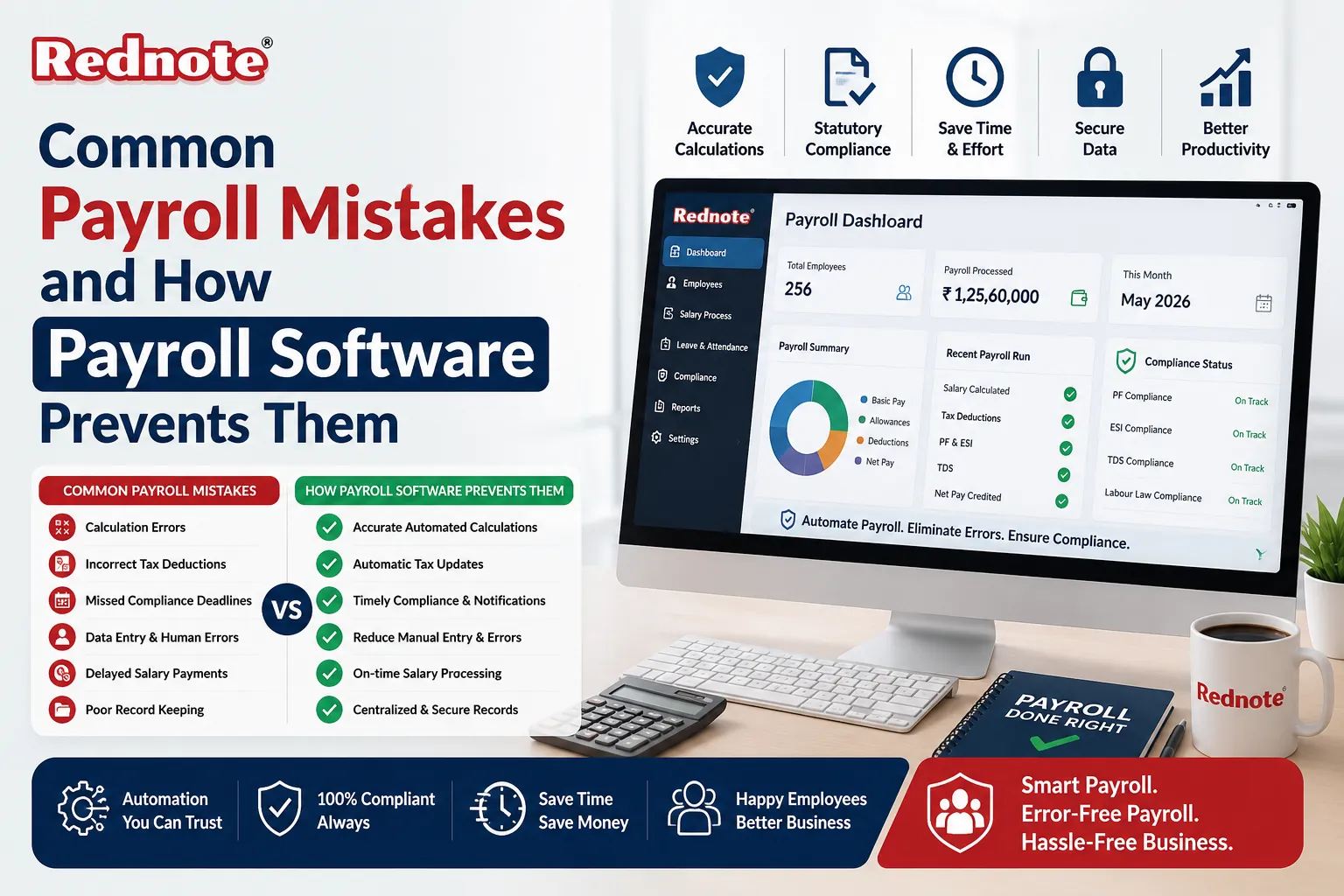
Common Payroll Mistakes and How Payroll Software Prevents Them
Ask any small business owner about their worst work week, and there's a good chance payroll shows up somewhere in that story. Maybe a decimal point got misplaced. Maybe overtime hours never made it into the calculation. Maybe a tax filing deadline slipped by unnoticed.
Payroll looks simple from the outside pay people the right amount, on time, and follow the rules. In practice, it's one of the most error-prone processes in any business, because it sits at the intersection of math, tax law, labor regulations, and human judgment.
In this guide, you'll learn the mistakes that trip up businesses most often, what they actually cost in money and trust, and how modern payroll software closes the gaps that manual processes leave open. Whether you're running payroll for five employees or five hundred, the patterns below will look familiar.
How Often Do Payroll Mistakes Actually Happen?
Short answer: Payroll errors are far more common than most business owners assume research consistently shows that a large share of paychecks contain at least one mistake, ranging from minor miscalculations to compliance violations that trigger penalties.
Even well-run finance teams make mistakes when payroll is handled manually or through outdated spreadsheets. The reason isn't carelessness it's complexity. Tax brackets change. Overtime rules vary by state. Employees switch between hourly and salaried status. Every variable is a place where a manual process can break down.
The Most Common Payroll Mistakes Businesses Make
Understanding where errors typically originate is the first step toward preventing them. Here are the mistakes that show up again and again, regardless of industry or company size.
-
Misclassifying Employees and Contractors
One of the most frequent Common Payroll Mistakes businesses make is misclassifying workers treating an employee as an independent contractor, or getting exempt versus non-exempt status wrong. This isn't just a paperwork issue. Misclassification affects tax withholding, overtime eligibility, and benefits obligations, and it's one of the top triggers for labor audits.
-
Incorrect Overtime Calculations
Overtime rules vary by jurisdiction, and manual tracking makes it easy to miss thresholds. A worker who picks up extra shifts during a busy season might be entitled to overtime pay that never gets calculated correctly if hours are tracked on paper or in disconnected spreadsheets.
-
Missed Tax Filing Deadlines
Payroll taxes come with strict, recurring deadlines at the federal, state, and sometimes local level. Missing even one filing date can trigger penalties and interest and these deadlines are easy to lose track of when they're managed manually across multiple calendars.
-
Data Entry Errors
A transposed number, a missing zero, an outdated bank account on file these small human errors are behind a surprising number of Payroll Processing Mistakes. They seem minor individually, but they add up to real financial and reputational damage over time.
-
Inconsistent Recordkeeping
Many businesses still store payroll records across multiple spreadsheets, email threads, and paper files. When records aren't centralized, it becomes difficult to produce accurate reports during audits, tax season, or employee disputes.
Payroll Errors and Solutions: What Each Mistake Actually Costs
It helps to think about payroll mistakes in terms of consequences, not just causes. Here's a practical breakdown of Payroll Errors and Solutions what typically goes wrong, and what actually fixes it.
| Common Mistake | Real-World Impact | Practical Fix |
|---|---|---|
| Employee Misclassification | Back Taxes, Fines, Legal Exposure | Automated Classification Checks |
| Overtime Miscalculation | Underpaid Wages, Labor Complaints | Real-Time Hour Tracking |
| Missed Tax Deadlines | Penalties and Interest Charges | Automated Filing Reminders/Submission |
| Data Entry Errors | Delayed Pay, Employee Frustration | Digital Forms with Validation |
| Poor Recordkeeping | Audit Risk, Reporting Delays | Centralized Digital Records |
| Outdated Compliance Rules | Non-Compliance Penalties | Automatic Regulatory Updates |
Notice a pattern? Nearly every solution column points toward the same underlying fix: replacing manual, fragmented processes with a connected, automated system.
How Payroll Software Prevents Errors Before They Happen
This is where How Payroll Software Prevents Errors becomes less theoretical and more practical. Modern platforms are built specifically to close the gaps that cause the mistakes listed above.
Automated calculations remove the human math error entirely. Hours, overtime, deductions, and tax withholding are calculated using current rules not last year's tax table someone forgot to update.
Built-in compliance updates mean the software adjusts automatically when minimum wage laws or tax brackets change, so businesses aren't relying on someone to catch every regulatory shift manually.
Centralized records keep every pay stub, tax form, and employee update in one searchable place, making audits and reporting far less stressful.
Direct integrations with time-tracking tools mean hours worked flow straight into payroll calculations, cutting out the manual re-entry step where so many errors originate.
Automated filing handles tax deadlines in the background, reducing the risk of a missed submission derailing an otherwise smooth quarter.
None of this eliminates the need for human oversight someone still needs to review outputs and approve runs but it shifts the role from "manually calculating everything" to "verifying that an accurate system is working correctly." That shift alone eliminates most of the errors covered earlier in this guide.
Benefits of Payroll Software Beyond Accuracy
Preventing mistakes is the headline reason businesses adopt automated systems, but the Benefits of Payroll Software extend well past error reduction.
- Time savings — What used to take days of manual calculation can often be completed in hours, freeing up HR and finance staff for higher-value work.
- Employee trust — Consistent, on-time, accurate pay builds confidence and reduces turnover-driving frustration.
- Scalability — Adding new employees, locations, or pay structures doesn't require rebuilding the process from scratch.
- Audit readiness — Reports and records are generated automatically, so audits become a matter of pulling data instead of reconstructing it.
- Cost predictability — Fewer penalties, fewer corrections, and fewer emergency fixes mean payroll becomes a predictable line item rather than a recurring surprise.
Common Mistakes When Switching to Payroll Software
Adopting the right tool doesn't guarantee a smooth transition. A few missteps show up often during implementation:
-
Migrating Incomplete Data
Carrying over incomplete or outdated employee records into the new system.
-
Skipping a Parallel Run
Not testing the new system alongside the old process for at least one pay cycle before fully switching over.
-
Ignoring Employee Training
Rolling out new self-service portals without showing staff how to use them.
-
Choosing Based on Price Alone
Selecting a platform without confirming it supports the specific tax jurisdictions and pay structures the business actually needs.
A short transition period, done carefully, prevents most of these issues from becoming ongoing headaches.
Final Thoughts
Payroll mistakes rarely come from negligence they come from complexity that manual processes simply weren't built to handle. Misclassified employees, miscalculated overtime, missed deadlines, and inconsistent records are all symptoms of the same root problem: too many manual steps and too little built-in oversight.
Automated systems don't just catch errors after the fact they prevent many of them from happening in the first place, while giving businesses better records, faster reporting, and more confident compliance.
If payroll has been a recurring source of stress for your business, it may be time to evaluate whether your current process is built for where your company is headed not just where it started.
Frequently Asked Questions