



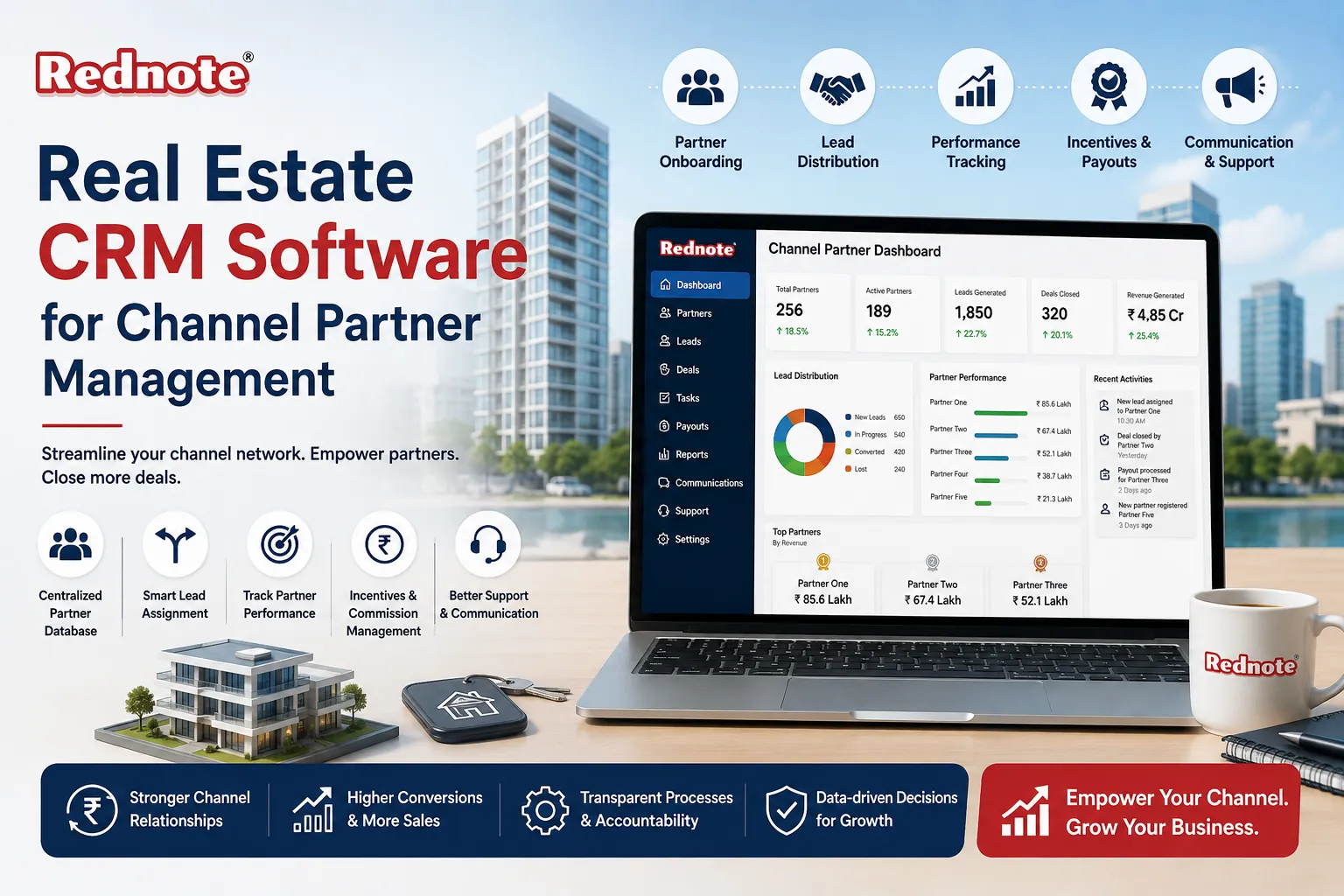
Real Estate CRM Software for Channel Partner Management
The real estate industry depends heavily on relationships. Developers, builders, and property firms often rely on channel partners, brokers, and sales associates to generate qualified leads and close property deals. While these partnerships create valuable business opportunities, managing them manually through spreadsheets, emails, and phone calls often leads to communication gaps, duplicate leads, delayed follow-ups, and missed revenue.
This is where a Real Estate CRM Software for Channel Partners becomes an essential business tool. A modern CRM centralizes partner information, automates routine tasks, tracks every interaction, and provides complete visibility into the sales pipeline. Instead of juggling multiple systems, sales teams and channel partners work from a single source of truth that improves collaboration and accelerates decision-making.
Whether you're launching a residential project, selling commercial spaces, or managing multiple developments across different cities, having the right CRM helps organize partner relationships while delivering a better buying experience for customers.
In this guide, you'll learn how CRM solutions improve channel partner management, the features that matter most, practical implementation strategies, common mistakes to avoid, and how to evaluate a CRM before investing in one.
Why Channel Partner Management Matters in Real Estate
Channel partners play a significant role in property sales. They connect developers with prospective buyers, provide market insights, and help projects reach wider audiences. However, managing dozens or even hundreds of partners introduce operational challenges.
Common issues include:
- Duplicate lead assignments
- Lack of transparency in commissions
- Delayed communication
- Missed follow-ups
- Difficulty measuring partner performance
- Inconsistent customer experiences
Without a structured process, sales teams spend valuable time resolving administrative problems instead of focusing on conversions.
Purpose-built Channel Partner Management Software addresses these issues by providing standardized workflows that make every stage of partner engagement easier to manage.
Challenges of Managing Partners Without a CRM
Many real estate companies begin with spreadsheets because they appear simple and inexpensive. As projects expand, these manual methods become difficult to maintain.
Some of the most common challenges include:
Scattered Customer Information
Lead details may exist across Excel sheets, WhatsApp conversations, emails, and handwritten notes. Finding complete customer information becomes time-consuming.
Poor Lead Distribution
When multiple partners receive the same lead, confusion develops over ownership, affecting both customer experience and commission calculations.
Delayed Follow-ups
Property buyers expect quick responses. Manual tracking often causes follow-ups to be forgotten, reducing conversion opportunities.
Limited Performance Insights
Without centralized reporting, management cannot accurately determine:
- Which partners generate quality leads
- Average sales cycle
- Conversion rates
- Revenue contribution
- Project-wise performance
Reliable reporting becomes increasingly important as the number of projects grows.
How CRM Improves Channel Partner Operations
Instead of acting as just a contact database, today's CRM platforms automate much of the sales lifecycle.
A well-designed CRM helps organizations.
| Business Activity | CRM Improvement |
|---|---|
| Lead Management | Automatic Lead Capture and Assignment |
| Communication | Centralized Conversations and Updates |
| Follow-ups | Automated Reminders and Task Scheduling |
| Documentation | Secure Storage of Agreements and Documents |
| Commission Tracking | Transparent Payment Records |
| Reporting | Real-Time Dashboards and Analytics |
| Team Collaboration | Shared Project Information |
These capabilities reduce manual work while improving consistency across departments.
Key Features Every Real Estate Business Should Look For
Not every CRM offers the same capabilities. Businesses should evaluate software based on operational needs rather than the number of available features.
Partner Registration
A CRM should allow businesses to register brokers and channel partners digitally while storing company details, documents, certifications, and communication history — a core function of any Real Estate Broker Management Software.
Smart Lead Allocation
Lead assignment rules reduce conflicts by automatically distributing inquiries according to predefined conditions such as project, location, or partner performance.
Automated Follow-up Scheduling
Automated reminders ensure every prospect receives timely communication throughout the buying journey.
Commission Management
Commission calculations should be transparent and traceable, reducing payment disputes while improving trust with partners.
Document Management
Contracts, pricing sheets, brochures, approvals, and payment documents should remain securely accessible from one platform.
Activity Timeline
Every interaction — including calls, meetings, emails, and site visits — should appear in chronological order, giving sales teams complete customer context before every conversation.
Benefits for Sales Teams and Channel Partners
A centralized CRM benefits everyone involved in the sales process.
For Sales Managers
Managers gain visibility into pipeline health, team productivity, and partner performance through real-time dashboards.
Benefits include:
- Better forecasting
- Faster approvals
- Improved accountability
- Standardized sales processes
- Easier project monitoring
For Channel Partners
Partners appreciate faster communication, transparent lead allocation, simplified document access, and timely commission updates.
This creates stronger long-term business relationships while reducing unnecessary disputes.
Practical Example
Imagine a property developer launching a new residential project with over 150 channel partners.
Without a CRM:
- Leads arrive through multiple channels.
- Sales executives manually assign prospects.
- Two brokers accidentally receive the same customer.
- Follow-ups are delayed.
- Commission calculations require manual verification.
With a centralized CRM:
- Every inquiry enters automatically.
- Leads are assigned instantly using predefined rules.
- Customer activity remains visible in one timeline.
- Managers monitor project performance in real time.
- Partners receive consistent communication throughout the sales cycle.
The result is a smoother workflow, better collaboration, and improved operational efficiency.
Choosing the Right CRM for Channel Partner Management
Selecting a Real Estate Partner Management CRM is a long-term business decision. The right platform should fit your current operations while giving you the flexibility to scale as your projects and partner network grow. Instead of comparing software based only on price, focus on how well it supports your sales process and collaboration needs.
Before making a decision, evaluate the following areas:
Ease of Adoption
A CRM should be intuitive for sales managers, marketing teams, and channel partners. If users find the system difficult to navigate, adoption rates will be low, reducing the value of your investment.
Look for:
- Simple dashboards
- Easy navigation
- Mobile accessibility
- Minimal training requirements
- Fast data entry
An easy-to-use platform encourages consistent usage across the organization.
Lead Lifecycle Management
Every lead follows a journey — from the first enquiry to booking and post-sale communication. A CRM should allow businesses to monitor each stage without losing visibility.
An effective solution helps teams:
- Capture enquiries from multiple sources
- Assign leads automatically
- Record every interaction
- Schedule follow-ups
- Track booking status
- Monitor conversion progress
Having a structured workflow helps ensure no opportunity is overlooked.
Reporting and Analytics
Good decisions rely on accurate data. Reporting tools should provide actionable insights instead of just raw numbers.
Useful reports include:
| Report | Business Value |
|---|---|
| Lead Source Performance | Identifies High-Performing Marketing Channels |
| Conversion Report | Measures Sales Effectiveness |
| Sales Funnel Report | Shows Where Leads Are Dropping Off |
| Partner Performance | Evaluates Productivity and Contribution |
| Revenue Dashboard | Tracks Project-Wise Sales Performance |
These reports help management identify trends, improve forecasting, and allocate resources more effectively.
Automation Capabilities
Automation reduces repetitive administrative work and allows sales teams to spend more time building relationships with prospective buyers.
Examples of useful automation include:
- Automatic lead assignment
- Reminder notifications
- Follow-up scheduling
- Email workflows
- Status updates
- Task creation
- Approval workflows
Automation also helps maintain consistency across projects, even as the number of enquiries grows.
Security and Access Control
Real estate companies manage sensitive customer information, pricing documents, agreements, and financial records. Protecting this data should be a priority.
Choose a CRM that offers:
- Role-based user permissions
- Secure cloud storage
- Data backup
- Audit logs
- Encryption
- Multi-factor authentication
These features reduce the risk of unauthorized access while supporting compliance with internal security policies.
Common Mistakes Businesses Make When Managing Channel Partners
Technology alone cannot solve operational problems. Many organizations fail to achieve expected results because of avoidable process issues.
Treating Every Partner the Same Not every partner contributes equally. Some consistently generate qualified buyers, while others may require additional support or training.
Segmenting partners based on performance allows businesses to:
- Offer targeted incentives
- Prioritize high-performing partners
- Improve engagement strategies
- Allocate resources more efficiently
Ignoring Data Quality Duplicate records, outdated contact details, and incomplete customer information reduce CRM effectiveness.
Establish clear guidelines for:
- Data entry
- Lead ownership
- Record updates
- Duplicate management
- Contact verification
Maintaining clean data improves reporting accuracy and decision-making.
Delaying Follow-ups The speed of response often influences whether a prospective buyer continues the conversation.
Set clear service-level expectations for:
- First response time
- Site visit scheduling
- Follow-up frequency
- Proposal sharing
- Booking confirmation
Timely communication creates a more professional customer experience.
Focusing Only on Lead Generation Generating enquiries is only one part of the sales process. Long-term success depends on nurturing relationships with partners and buyers throughout the sales cycle.
Businesses should also measure:
- Customer satisfaction
- Partner engagement
- Repeat business
- Referral rates
- Sales cycle duration
A balanced approach leads to stronger business outcomes over time.
How to Measure CRM Success
After implementation, organizations should regularly evaluate whether the CRM is delivering measurable improvements.
Key performance indicators include:
| KPI | Why It Matters |
|---|---|
| Lead Response Time | Measures Sales Efficiency |
| Lead-to-Booking Ratio | Evaluates Conversion Performance |
| Average Sales Cycle | Identifies Process Improvements |
| Active Channel Partners | Tracks Partner Engagement |
| Customer Follow-up Rate | Ensures Consistent Communication |
| Revenue per Project | Measures Business Growth |
Reviewing these metrics monthly helps identify opportunities for optimization and supports continuous improvement.
Evaluating CRM ROI
Business leaders often ask whether a CRM for Real Estate Sales Partners provides measurable returns. The answer depends on how effectively the organization uses the platform. Instead of measuring software costs alone, evaluate improvements in business performance.
Areas to assess include:
| Metric | Expected Improvement |
|---|---|
| Lead Response Time | Faster Customer Engagement |
| Conversion Rate | Higher Booking Percentages |
| Sales Productivity | More Qualified Conversations |
| Administrative Work | Reduced Manual Effort |
| Customer Satisfaction | Better Buying Experience |
| Partner Retention | Stronger Long-Term Relationships |
Future Trends in Real Estate CRM
The real estate industry continues to evolve, and CRM platforms are becoming more intelligent and connected.
Businesses adopting modern technologies today will be better prepared for changing customer expectations.
Emerging trends include:
- AI-assisted lead scoring
- Predictive sales forecasting
- Voice-enabled CRM interactions
- Advanced mobile applications
- Digital document workflows
- Integrated customer communication platforms
- Enhanced business intelligence dashboards
While technology continues to advance, the core purpose of a CRM remains the same: helping organizations build stronger customer and partner relationships through better information management.
Conclusion
Managing channel partners effectively requires more than spreadsheets and manual follow-ups. As real estate businesses expand, maintaining visibility across leads, customer interactions, partner activities, and sales performance become increasingly challenging.
A well-planned CRM implementation helps streamline operations, improve communication, automate repetitive tasks, and provide valuable insights for better decision-making. From lead allocation and commission tracking to reporting and collaboration, the right CRM creates a structured process that benefits sales teams, channel partners, and customers alike.
Rather than viewing a CRM as just another software application, businesses should treat it as a long-term investment in operational efficiency and relationship management. Organizations that establish clear processes, maintain accurate data, train users effectively, and continuously monitor performance are better positioned to improve productivity and deliver consistent customer experiences.
If you're evaluating CRM solutions, begin by mapping your existing sales workflow, identifying operational challenges, and selecting a platform that aligns with your current needs while supporting future growth. A thoughtful implementation today can create a stronger, more scalable sales operation for years to come.
Frequently Asked Questions
- Lead capture and assignment
- Contact management
- Sales pipeline tracking
- Activity reminders
- Commission tracking
- Document management
- Mobile access
- Custom reports and dashboards
- Role-based permissions
- Workflow automation
Choosing features based on your business requirements is more valuable than selecting software with the longest feature list.
- Provide practical user training
- Keep workflows simple
- Define clear responsibilities
- Maintain accurate customer data
- Monitor usage regularly
- Gather employee feedback
- Continuously improve processes
When employees see how the CRM saves time and simplifies their work, consistent adoption becomes much easier.