



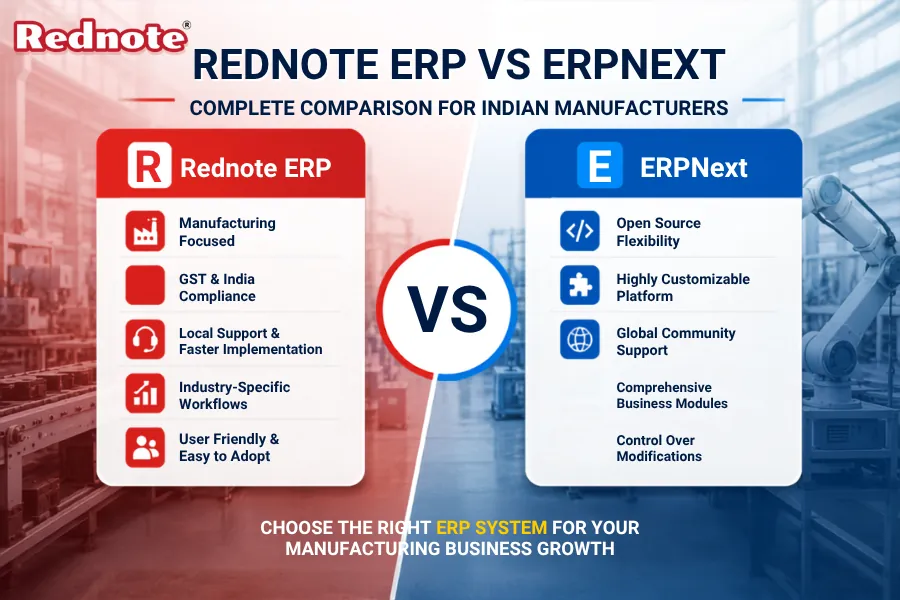
Rednote ERP vs ERPNext: Complete Comparison for Indian Manufacturers
Selection of the proper ERP system plays a vital role in the growth of a manufacturing company. At present, the Indian manufacturers need a solution which can automate their processes as well as meet the compliance needs and future plans of the company.
The two common ERP systems used by manufacturing companies are Rednote ERP and ERPNext. Even though ERPNext has become a popular name among the open source systems, Rednote ERP is one that is built especially for the Indian companies and manufacturing industries.
In this comparative analysis, we will compare Rednote ERP and ERPNext according to various aspects.
Understanding ERP for Manufacturing Businesses
A good ERP system would bring together all the different departments such as manufacturing, procurement, inventory, finance, HR, and sales to create a single system. Instead of using disjointed spreadsheets and application software, manufacturers can simplify their processes through this unified approach.
ERP software for India businesses must assist in increasing efficiency, reducing waste, remaining compliant and giving visibility on how well the business is performing.
What is Rednote ERP?
Rednote ERP is an ERP software that is built for businesses in India with special emphasis placed on manufacturing processes. It provides solutions for issues such as compliance with the GST laws, inventory control, manufacturing process, and financial management.
Some of the key strengths include:
- Special emphasis on manufacturing process
- Financial modules ready to comply with GST rules
- Special assistance in implementation of the system locally
- Custom support services
What is ERPNext?
ERPNext is an open-source ERP software package utilized by companies around the world, regardless of their size. The following features are available: accounting, CRM, manufacturing, HR, inventory, and project management.
As a result of being open source, it allows a company to personalize it greatly. Nevertheless, implementing it usually needs some knowledge or help from third parties.
It is recommended for organizations that have strong IT support within their company.
Rednote ERP vs ERPNext: Feature Comparison
| Feature | Rednote ERP | ERPNext |
|---|---|---|
| Manufacturing Focus | Strong manufacturing specialization | General-purpose ERP |
| GST Compliance | Built specifically for Indian regulations | Available with configuration |
| Implementation Time | Faster deployment | Moderate to lengthy |
| Local Support | Dedicated Indian support | Depends on implementation partner |
| Customization | Guided customization | Highly customizable |
| Technical Expertise Needed | Minimal | Moderate to high |
| Inventory Management | Advanced | Comprehensive |
| Production Planning | Industry-focused | Available |
| Cost Predictability | Structured pricing | Variable implementation costs |
| Training Assistance | Included support | Partner dependent |
Manufacturing Capabilities
The manufacturing companies have specific workflow needs that may not be met by normal business applications.
Some of the features offered by Rednote ERP are as follows:
- Bill of Materials management
- Production planning
- Work order management
- Material Requirement Planning
- Shop floor management
- Quality control management
- Vendor management
The other ERP software that provides manufacturing facilities is ERPNext.
But, in some cases, more configurations are required to meet the manufacturing processes used in India.
In this case, Rednote ERP gives an advantage to manufacturing companies in India.
GST and Indian Compliance
Compliance remains one of the most important factors to consider in Indian companies.
Rednote ERP is built based on the tax rules of India. Reporting, invoicing, taxation processes, and other statutory factors are incorporated in the software.
GST functionality is provided by ERPNext although it may need setting up and testing based on the company's needs.
Many manufacturers seek systems that will have low compliance difficulties and thus tend to use localized ERP software in India.
Implementation and User Adoption
Successful ERP implementation relies to a large extent on the quality of implementation and employees’ acceptance.
Rednote ERP usually concentrates on guided implementation, where employees get help with deployment, data migration, user training, and go live after.
Implementations of ERPNext systems differ widely, since they depend on the particular implementation partner and internal capabilities.
The lack of IT department in some companies makes them like the hands-on approach that ERP Chennai professionals provide.
Customization Flexibility
Each manufacturing firm works in its own way.
ERPNext’s open source architecture allows a lot of room for customization.
Customization includes modifying processes, developing applications, and extending functionality.
Rednote ERP delivers a well-defined customization solution that conforms to industry standards without any extra complexity.
It is necessary for organizations to be aware whether they need full freedom or easy installations.
Support & Maintenance
Support is of prime importance once the installation is done.
Rednote ERP focuses on offering continuous support to customers and helps firms overcome operational problems effectively.
The quality of support available from ERPNext largely hinges upon its implementation partners.
It becomes particularly useful when manufacturers have production deadlines and cannot afford any disruptions in their systems.
Pricing Considerations
Open-source software is often seen as economical.
But companies should consider the following total cost of ownership factors:
- Implementation cost
- Customization cost
- Training cost
- Maintenance cost
- IT staffing
- Upgrades in the future
Rednote ERP usually provides predictable pricing models; ERPNext prices vary according to the complexity of customization.
Choosing an ERP software solution based on the licensing cost alone may lead to overlooking critical costs in the long term.
ERP Solution for Indian Manufacturing: Which is better?
It all depends on company needs.
Choose Rednote ERP if you need:
- Workflows that meet manufacturing requirements
- Compliance with Indian regulations
- Availability of local support team
- Speedy implementation
- Low reliance on technology
- Consistent deployment process
Choose ERPNext if you need:
- Open-source solution
- High custom development
- Advanced IT team
- Access to a global community
- Total control of customization
Rednote ERP is a perfect option for many emerging Indian manufacturing companies.
Pro Tip
Pro Tip: Always make a detailed report about your current manufacturing operations and the future development plans. Make an evaluation of the way each system facilitates your business goals. Don’t go by the popularity or the initial price when deciding which one to opt for because the correct ERP software India companies use will be able to facilitate the future for five to ten years.
The decision about using either Rednote ERP or ERPNext will always be a tactical one. While both offer huge benefits, their strengths are used by different types of businesses.
Companies in need of a local touch, support with compliance and implementation services usually prefer using Rednote ERP. On the other hand, businesses with good technical capabilities and customization demands can benefit from ERPNext.
As competition keeps growing in different industries, the investment into the right ERP software will become increasingly important for increasing productivity and growth. Your business looking for reliable ERP software Chennai solutions that have a good understanding of manufacturing challenges in India can benefit a lot from using Rednote ERP.
Frequently Asked Questions