



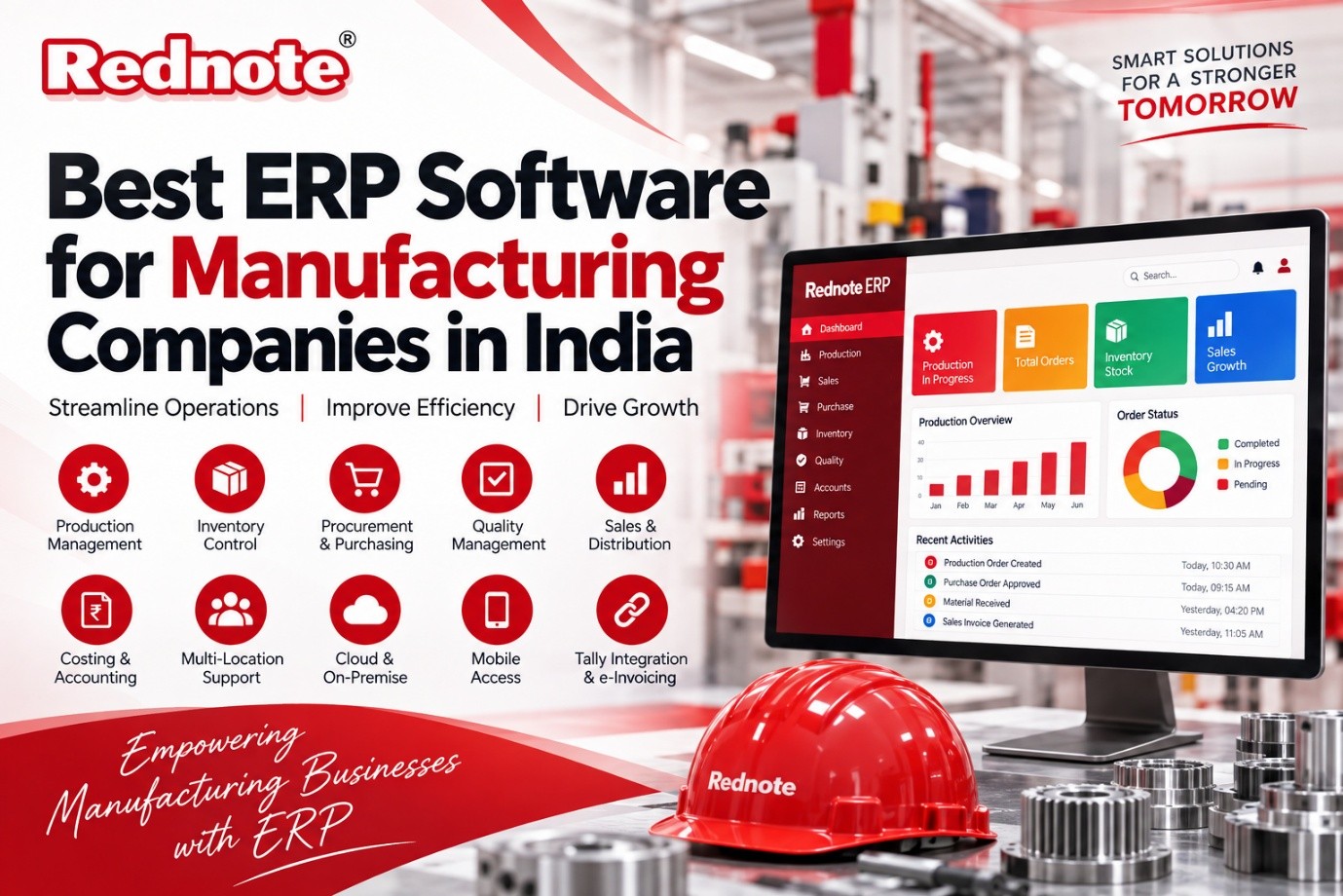
Best ERP Software for Manufacturing Companies in India
The Indian manufacturing sector is experiencing an unprecedented phase of modernization. With initiatives like Make in India driving rapid industrial growth, companies are scaling up production lines, expanding supply chains, and entering global markets. However, with expansion comes operational complexity. Managing raw materials, tracking multi-tier production schedules, maintaining quality compliance, and optimizing warehouse inventory using outdated spreadsheets often results in expensive downtime and missing delivery deadlines. To stay competitive, modern enterprises require robust digital infrastructure, and choosing the Best ERP software is the single most critical technology decision a factory leader can make today.
Whether you operate in discrete manufacturing, process manufacturing, batch chemical production, or automotive component fabrication, implementing a specialized ERP software India platform unifies your shop floor, sales teams, and procurement departments into a single source of truth.
In this comprehensive guide, we examine why modern factories are ditching legacy setups, key modules every production floor needs, and how top-tier platforms like Rednote are transforming shop floor efficiency across the nation.
The Rising Need for Digital Transformation in Indian Manufacturing
Managing a modern production plant involves hundreds of dynamic variables every single day. Without unified software tracking these variables, inventory stockouts halt entire lines, material wastage spikes, and customer deliveries get delayed.
Traditional generic accounting applications simply cannot handle shop floor complexities such as multi-level Bill of Materials (BOM), sub-contracting tracking, parameter-based quality control, or stage-wise work order management. Indian manufacturers need an agile system tailored specifically to local tax regulations (such as GST e-Invoicing and e-Way bills), variable lead times, and multi-warehouse structures.
Deploying a dedicated ERP software for manufacturing company operations helps bridge the traditional gap between sales order receipts and final product dispatch. By automating Material Requirement Planning (MRP) and inventory valuation, business owners gain real-time control over exact operational costs and profit margins per unit.
Core Modules to Look For in a Manufacturing ERP Software
When evaluating solutions for your facility, ensure the system is built specifically for production workflows rather than basic retail inventory. A modern Manufacturing ERP software platform must provide these end-to-end operational capabilities:
1. Sales Order Tracking & MRP (Material Requirement Planning)
Every efficient production line starts with clear customer orders. Once your sales team logs a sales order, the system should automatically trigger an MRP check against your Bill of Materials (BOM). If raw materials or semi-finished items fall short, the system alerts procurement to raise a Purchase Order (PO) with a single click, eliminating manual inventory miscalculations.
2. Batch & Lot Tracking with Reverse Traceability
For industries like chemical formulation, pharmaceuticals, food processing, and electronics, quality tracking is paramount. Assigning unique batch and lot numbers during raw material Goods Receipt Notes (GRN) ensures complete end-to-end traceability. If a defect occurs post-delivery, you can instantly trace back the exact batch of raw material, vendor details, and stage-wise production operator responsible.
3. Multi-Warehouse & Shelf Level Management
Managing complex storage layouts across central plants and regional depots requires precision. Advanced systems allow you to map unlimited warehouses down to specific shelf details. When stock moves from staging to production or finished goods, operators record exact shelf transfers, reducing item loss and stock search times.
4. Sub-contracting & Vendor Operations
Outsourcing specialized operations—such as heat treatment, plating, or surface finishing—is common practice in Indian industrial clusters. A specialized platform simplifies subcontracting by tracking raw material sent to external job workers, monitoring scrap percentages, and reconciling finished goods received against job orders.
5. Automated Quality Control (QC)
Inconsistent output ruins client relationships. Integrated quality control allows quality engineers to perform parameter-based inspections and quantity validations at two primary checkpoints: upon raw material entry (GRN) and immediately following finished goods assembly.
6. eInvoicing, Tally Integration & Statutory Compliance
Indian operations require full compliance with GST guidelines. Leading software generates e-Invoices and e-Way bills with one click. Additionally, seamless two-way synchronization with accounting platforms like Tally ensures your accounting team maintains parallel ledger accuracy without double data entry.
Key Benefits of Implementing ERP Software in India
Adopting digital workflows yields clear financial returns across factory floors:
- Elimination of Production Bottlenecks: Real-time visibility across work centers ensures machine downtime is addressed immediately and material bottlenecks are spotted before lines stall.
- Accurate Production Costing: Automatically aggregate costs from raw materials, direct labor, equipment depreciation, and overheads to identify exact unit profit margins.
- Reduced Inventory Holding Costs: Automated low-stock alerts and safety stock calculations prevent capital tie-up in excess raw materials.
- Faster Sales Fulfillment: Delivery Challans (DC) automatically sync with finished goods inventory to generate shipping documents and tax invoices immediately upon dispatch.
- Flexible Deployment Options: Top systems offer flexible deployment—cloud hosting for accessible multi-site management, or on-premise installation for complete internal data sovereignty.
For factories seeking a scalable, feature-packed digital backbone, platforms available at Rednote deliver customized modules tailored specifically to local operational hurdles, supporting both small-to-medium enterprises and large-scale multi-location production setups.
Strategic Evaluation Checklist for Factory Owners
Before committing capital to digital upgrades, guide your leadership team through this quick evaluation matrix:
| Feature Criteria | Legacy Spreadsheet Setup | Standard Accounting Tool | Specialized Manufacturing ERP |
|---|---|---|---|
| Material Requirement Planning (MRP) | Manual calculation, error-prone | Not supported | Automated against real-time sales orders & BOM |
| Batch & Serial Tracking | High risk of human oversight | Basic text tagging | End-to-end parameter tracking & reverse traceability |
| Multi-Location & Shelf Control | Near impossible to track in real time | Single warehouse view | Unlimited warehouses down to specific shelf locations |
| Subcontracting Management | Tracked via external registers | Manual voucher entries | Automated job work tracking, material balance & scrap accounting |
| Tax & e-Invoicing Compliance | Manual portal uploading | Basic GST entry | One-click direct portal synchronization |
Implementation Steps for Smooth Onboarding
Switching software environments can disrupt daily output if mismanaged. Follow this structured roadmap to guarantee a smooth transition:
- Audit Existing Workflows: Document every step from sales order entry, raw material requisitioning, and shop floor conversion, to final customer invoicing.
- Standardize Master Data: Clean up existing item codes, vendor details, customer master records, and multi-tier Bill of Materials (BOM) files before migration.
- Configure User Roles & Approval Hierarchies: Set strict user permissions and approval configurations for high-value purchase orders, production releases, and financial vouchers.
- Run Pilot Testing: Execute sample production orders in a sandbox environment to test edge cases—such as partial raw material deliveries, defective quality holds, or job work rejections.
- Role-Based Staff Training: Conduct targeted training sessions for purchase officers, warehouse supervisors, shop-floor engineers, and billing teams.
Driving Industrial Growth with the Right Platform
In an competitive industrial landscape, relying on manual calculations and fragmented software is a liability. Implementing the Best ERP software designed for factory operations empowers manufacturers to automate workflows, control material usage, cut operational expenses, and maintain strict quality standards across all production runs.
When searching for the ideal digital partner, Indian companies need an intuitive, feature-rich, and scalable system that easily adapts to shifting business demands. Explore how flexible solutions from Rednote can digitize your shop floor, optimize your supply chain, and accelerate sustainable business growth.