



CRM vs ERP Software: What's the Difference?
Choosing the right business software can be confusing, especially when terms like CRM and ERP are often used together. Both systems help businesses manage important operations, improve productivity, and make better decisions. However, they are designed for different purposes.
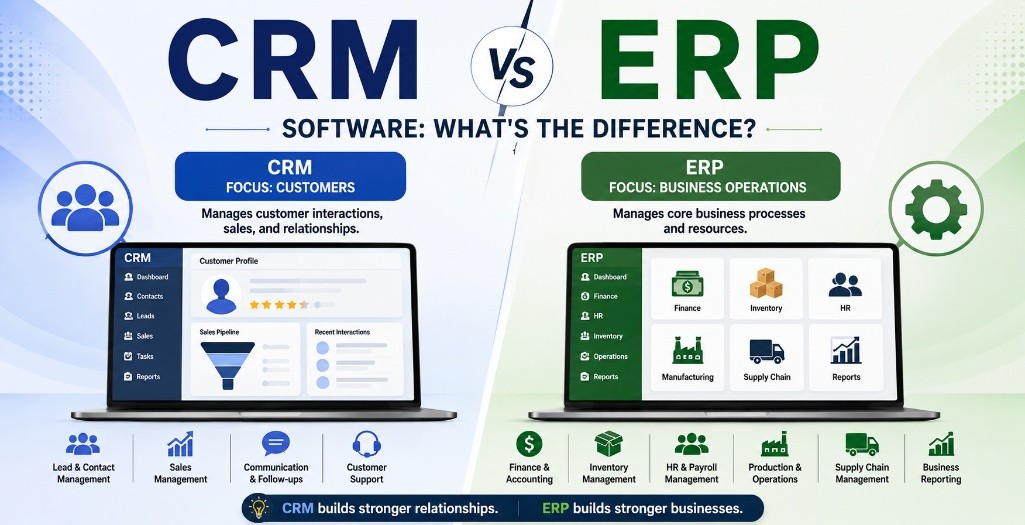
A CRM Software system focuses mainly on customers, leads, sales, marketing, and communication. An ERP (Enterprise Resource Planning) system takes a broader approach by connecting multiple business functions such as finance, inventory, procurement, operations, human resources, and supply chain management.
Understanding the difference between CRM and ERP software can help businesses choose the right solution based on their goals, size, processes, and future growth.
CRM software is designed to help businesses manage relationships and interactions with current and potential customers. It brings customer information into one central system so sales and marketing teams can track leads, follow up with prospects, manage opportunities, and maintain customer relationships.
Instead of keeping customer information in spreadsheets, emails, notebooks, and different applications, a CRM allows teams to manage this information from a single platform.
Typical CRM features include:
- Lead management
- Contact management
- Sales pipeline management
- Customer communication tracking
- Follow-up reminders
- Email integration
- Marketing automation
- Sales reporting
- Customer support management
- Customer history and activity tracking
For example, a company receiving enquiries from its website, social media, phone calls, and online campaigns can use CRM software to record these leads and track their progress from initial enquiry to completed sale.
What Is ERP Software?
ERP software is built to manage and integrate the core internal operations of a business. Rather than focusing primarily on customers, ERP connects different departments and business processes through a centralized system.
An ERP platform can help businesses manage:
- Finance and accounting
- Inventory
- Purchasing
- Sales orders
- Procurement
- Manufacturing
- Supply chain operations
- Human resources
- Business reporting
- Warehouse management
- Project management
The biggest advantage of ERP software is integration. Information entered by one department can often be used by other departments without manually transferring data between separate systems.
For example, when a sales order is created, an ERP system can connect that transaction with inventory availability, purchasing requirements, invoicing, accounting records, and operational reporting.
CRM vs ERP: The Main Difference
The simplest way to understand the difference is this:
CRM is primarily customer-focused, while ERP is primarily business-operation-focused.
CRM helps answer questions such as:
- How many leads do we have?
- Which prospects need follow-up?
- What is the sales pipeline?
- Which customers have purchased from us?
- How are our sales representatives performing?
ERP helps answer questions such as:
- What is our current inventory?
- What are our expenses and revenues?
- Which purchase orders are pending?
- How much stock is available?
- What are the operational costs?
- What is the overall financial position of the business?
Both systems can provide valuable business data, but their areas of focus are different.
CRM vs ERP Software Comparison
| Feature | CRM Software | ERP Software |
|---|---|---|
| Primary purpose | Manage customer relationships | Manage business operations |
| Main users | Sales, marketing, customer service | Finance, operations, HR, procurement, management |
| Main focus | Leads, customers and sales | Finance, inventory, operations and resources |
| Lead management | Strong | Usually limited |
| Sales pipeline | Strong | Basic or integrated |
| Customer support | Strong | May be available |
| Accounting | Usually limited or integrated | Core functionality |
| Inventory management | Basic or limited | Advanced |
| Procurement | Limited | Strong |
| Human resources | Usually limited | Commonly available |
| Financial reporting | Limited | Strong |
| Best suited for | Customer-focused growth | Integrated business management |
CRM and ERP: Different Goals, Different Benefits
Although CRM and ERP systems may share some features, their objectives are different.
A CRM is generally used to increase sales efficiency and improve customer relationships. It helps businesses understand their customers and organize the sales process.
An ERP is generally used to improve operational efficiency and connect business functions. It provides management with a broader view of how different departments work together.
For example, a growing digital marketing agency may benefit significantly from CRM software because managing leads, client enquiries, proposals, and follow-ups is a major part of its daily work.
On the other hand, a manufacturing company may require ERP software because it needs to manage raw materials, production, inventory, purchasing, accounting, and supply chain activities.
When Should a Business Choose CRM Software?
CRM software can be a better choice when customer acquisition and sales management are the biggest priorities.
Businesses should consider CRM when they:
- Have a growing number of leads
- Need a structured sales pipeline
- Have multiple sales representatives
- Want better follow-up management
- Need centralized customer information
- Want to track customer interactions
- Are losing leads because of poor follow-up
- Need better sales forecasting
- Want to improve customer retention
For businesses that mainly struggle with sales organization and customer management, implementing a full ERP system may be unnecessary at the beginning.
When Should a Business Choose ERP Software?
ERP software becomes more valuable when a company needs to manage multiple interconnected business processes.
A business may consider ERP when it:
- Has multiple departments
- Manages significant inventory
- Handles purchasing and procurement
- Needs integrated accounting
- Has manufacturing operations
- Operates multiple warehouses or locations
- Needs centralized operational data
- Wants real-time management reporting
- Is experiencing problems caused by disconnected systems
ERP can be particularly useful when employees are entering the same information into multiple systems or when departments cannot easily access accurate business data.
Can a Business Use Both CRM and ERP?
Yes. Many businesses use both CRM and ERP because they solve different problems.
The CRM can manage the customer-facing side of the business, while the ERP can manage internal operations.
For example, imagine a customer purchases products from an online business.
The CRM may store:
- Customer details
- Previous interactions
- Sales communications
- Lead and opportunity history
The ERP may manage:
- Product availability
- Inventory
- Order processing
- Invoicing
- Accounting
- Procurement
When CRM and ERP systems are properly integrated, information can move between customer-facing and operational processes more efficiently.
CRM vs ERP Integration
Integration is especially important for growing businesses.
Consider a sales representative closing a large customer order. The CRM records the customer and sales opportunity. Once the order is confirmed, relevant information can be transferred to the ERP system for inventory, fulfilment, invoicing, and accounting.
This reduces duplicate data entry and gives teams access to more consistent information.
However, integration should be planned carefully. Businesses need to consider data synchronization, user permissions, APIs, security, reporting requirements, and the specific capabilities of both platforms.
Which Is More Important for a Small Business?
There is no universal answer.
A small business should choose software based on its biggest operational challenge rather than simply choosing the system with more features.
If the primary challenge is generating leads, managing prospects, and improving sales follow-ups, CRM software may provide more immediate value.
If the business manages inventory, purchasing, accounting, production, and several departments, ERP software may be more appropriate.
Some businesses may start with CRM and later implement ERP as their operations become more complex. Others may start with ERP and add CRM functionality or integrate a dedicated CRM platform later.
Pro Tip
Don't choose CRM or ERP based only on the number of features. Map your current business processes first. Identify where data is being duplicated, where employees spend the most manual time, and where important information gets lost. Then choose the software that solves your biggest business problem.
Key Factors to Consider Before Choosing CRM or ERP
Before investing in business software, consider more than the feature list.
1. Business Size
A small company with a simple sales process may not need a complex ERP platform. Similarly, a large organization may quickly outgrow a basic CRM.
2. Business Process Complexity
Businesses with complex procurement, manufacturing, inventory, finance, and supply chain processes often benefit from ERP.
Businesses with complex sales cycles and customer relationships often benefit from CRM.
3. Number of Users
Consider how many employees will use the software and which departments need access.
4. Integration Requirements
Check whether the software can integrate with your website, accounting platform, payment gateway, email system, e-commerce platform, or other business applications.
5. Scalability
The system should support business growth. Switching software repeatedly can be expensive and disruptive.
6. Ease of Use
A powerful system is not useful if employees struggle to use it. User experience, training, and adoption should be part of the evaluation.
7. Total Cost
Don't look only at the monthly subscription. Consider implementation, customization, integrations, training, maintenance, data migration, and support costs.
CRM vs ERP: Which One Should You Choose?
The right choice depends on what your business needs most.
Choose CRM software if your primary goal is to improve lead management, sales performance, customer communication, and retention.
Choose ERP software if your primary goal is to connect finance, inventory, procurement, operations, HR, manufacturing, or other internal processes.
Choose both CRM and ERP if your organization needs strong customer management as well as integrated business operations.
The important thing is to avoid buying software simply because it is popular or has an extensive feature list. The best solution is the one that fits your existing processes and supports your future growth.
Final Thoughts
CRM and ERP software are not competing solutions in every situation. They are designed to address different areas of business management.
CRM focuses on customers, leads, sales, and relationships, while ERP focuses on resources, operations, finance, inventory, and business processes.
For a business focused on improving sales and customer engagement, CRM can be a valuable investment. For an organization struggling with disconnected internal processes, ERP can provide the centralized platform it needs.
As businesses grow, the distinction can become less important than integration. A well-connected CRM and ERP environment can give management a more complete view of customers, sales, operations, and financial performance.
The best starting point is to identify your business's biggest challenge, understand which processes need improvement, and then select a software solution that addresses those needs without adding unnecessary complexity.