



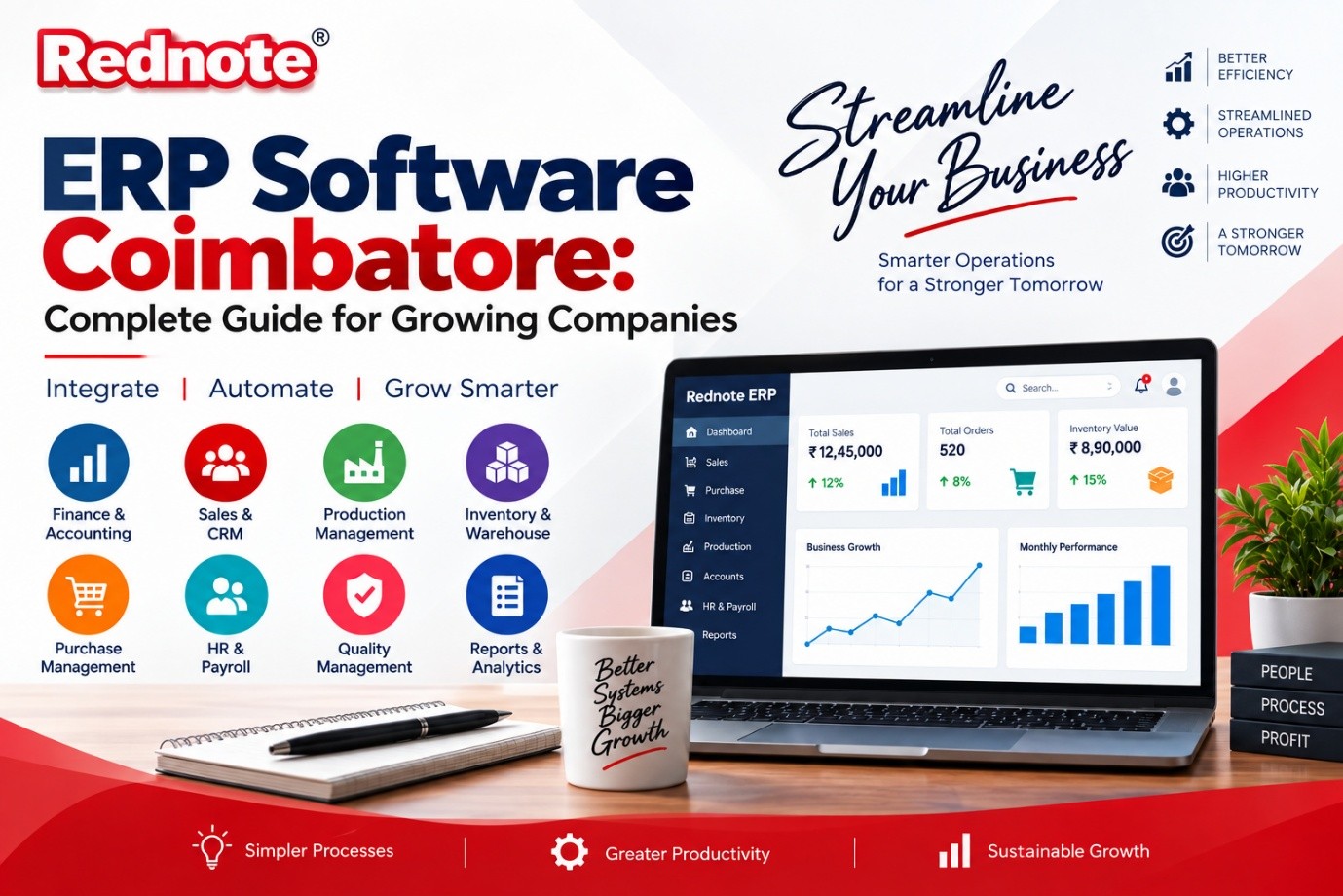
ERP Software Coimbatore: Complete Guide for Growing Companies
Coimbatore, famously recognized as the "Manchester of South India," has built its reputation on engineering excellence, textile innovation, and a vibrant culture of small and medium-scale enterprises (SMEs). Today, local foundries, auto-component suppliers, textile mills, and emerging technology startups face a shared challenge: scaling operations efficiently without ballooning administrative overhead. Relying on disconnected spreadsheets, manual logbooks, or entry-level accounting tools creates data silos, inventory leakage, and delayed deliveries. Implementing a modern ERP software Coimbatore organization trust helps bridge the gap between operational effort and measurable business performance.
Transitioning to a unified Enterprise Resource Planning system brings clarity to daily workflows. Instead of maintaining separate records for raw material purchases, machine maintenance, sales orders, and payroll, a centralized digital backbone records every transaction in real time. This complete guide explores how businesses across Tamil Nadu's industrial heartland can leverage smart software solutions to automate routine tasks, reduce operational costs, and build a resilient foundation for long-term expansion.
The Evolving Business Landscape in Coimbatore
The industrial ecosystem in Coimbatore is uniquely diverse. Unlike metro cities dominated primarily by IT services, the region's economy relies heavily on physical manufacturing, precision fabrication, job-work processing, and international exports.
As market conditions fluctuate and supply chains become increasingly complex, local companies encounter several operational hurdles:
- Fragmented Data: When purchasing, sales, and production teams work on isolated spreadsheets, management lacks a single source of truth.
- Subcontracting & Job Work Losses: Tracking raw materials sent to third-party vendors (and accounting for scrap or yields) often leads to unaccounted losses.
- Inventory Imbalances: Excess raw materials tie up cash flow, while unexpected stockouts pause assembly lines and delay customer shipments.
- Compliance Delays: Keeping up with GST filings, E-Way bills, payroll taxes, and ISO audit standards consumes valuable manual hours.
To stay competitive on both national and international stages, local enterprises are turning to digital transformation. Adopting dedicated ERP software Coimbatore manufacturers count on provides the visibility needed to control shop floor workflows, optimize material usage, and protect profit margins.
Core Modules That Drive Enterprise Growth
An integrated system acts as the central engine of your organization, connecting departments so information flows automatically from one stage to the next. Solutions like Rednote ERP offer a comprehensive suite tailored to regional operating models:
1. Production Planning & Scheduling
The production floor is where revenue is generated, but it is also where time and resources are easily lost. Advanced production modules allow managers to generate accurate schedules based on real-time machine capacity, available inventory, and delivery targets.
Automated multi-level Bill of Materials (BOM) management ensures every component—from raw casting to final surface coating—is accounted for before a job order is released.
2. Warehouse & Inventory Control
Inventory represents tied-up capital. Modern system architectures provide precise stock tracking across multiple warehouses and shop floor bins. Automated reorder alerts prevent stockouts of critical spare parts, while batch and lot tracking ensure full traceability—a non-negotiable requirement for automotive, medical device, and food manufacturing sectors.
3. Subcontracting & Vendor Management
Outsourced processing is a defining feature of the Coimbatore manufacturing sector. Managing raw material movement between your plant and external job workers requires close oversight. A robust system tracks material dispatch, calculates yield percentages, handles vendor billing, and reconciles incoming finished parts automatically.
4. Quality Assurance & Compliance
Maintaining consistent quality protects your reputation. Embedded quality control checkpoints ensure incoming raw materials, in-process assemblies, and finished products undergo systematic inspection. Defect tracking helps engineering teams identify root causes quickly and comply with ISO norms and customer-specific quality requirements.
5. Sales, Accounts & GST Management
From quotation generation to proforma invoicing and sales order tracking, automating the customer lifecycle speeds up order processing. Integrated accounting features link sales ledger entries directly with banking, purchase orders, and GST compliance portals, eliminating duplicate data entry and simplifying monthly financial closing.
6. Payroll & HRMS
Managing workforce attendance, shift rotations, overtime calculations, and statutory deductions (such as PF and ESI) can be complex in labor-intensive sectors like textiles and engineering. Integrated HRMS tools automate monthly salary processing, keeping your business fully compliant with local labor regulations while ensuring employees are paid accurately and on time.
Why Local Alignment Matters: The Rednote Difference
Generic enterprise platforms often fail in mid-market environments because they are overly complex, expensive to customize, and lack localized support. Choosing ERP software Coimbatore businesses rely on—such as Rednote ERP—delivers several distinct advantages:
- Industry-Specific Workflows: Pre-built configurations for discrete manufacturing, textile production, metal fabrication, plastics, and pharmaceutical processing reduce the need for expensive custom coding.
- Deployment: Thanks to modular architectures, companies can go live within 2 to 4 weeks instead of enduring painful, months-long implementation cycles.
- Localized Support: Having access to experts who understand regional business practices and provide hands-on assistance in both English and Tamil makes onboarding smooth and stress-free for shop floor operators.
- Affordable Scalability: A flexible pricing model allows growing businesses to start with essential modules—like inventory and invoicing—and add advanced features like shop floor control or CRM as their operations expand.
Step-by-Step Implementation Roadmap
Implementing a new operational core is a strategic investment. Following a structured roadmap ensures high adoption rates and minimal disruption to your daily routine:
- Audit Existing Workflows: Identify your biggest pain points—whether that means inventory leakages, late customer deliveries, or delayed invoice generation.
- Define Clear Objectives: Set measurable goals, such as cutting inventory holding costs by 15% or reducing order-to-dispatch turnaround time.
- Involve Key Stakeholders Early: Bring shop floor supervisors, store managers, and finance teams into the evaluation process early to build trust and gather practical feedback.
- Cleanse Your Data: Before migrating, audit your master records—including part numbers, customer lists, and vendor profiles—to avoid carrying outdated or duplicate information into the new system.
Realizing Long-Term Value
Investing in a tailored operational platform is more than an IT upgrade; it is a business growth strategy. By eliminating manual coordination and centralizing operational data, leadership teams can move from reactive firefighting to proactive management. Real-time dashboards provide immediate visibility into profitability per job order, machine utilization rates, and cash flow trends.
Whether you run an established engineering foundry in Peelamedu, a textile unit in Tirupur, or a growing machinery startup, selecting the right ERP software Coimbatore provider helps streamline workflows, safeguard product quality, and empower your team to achieve sustainable, profitable growth.