



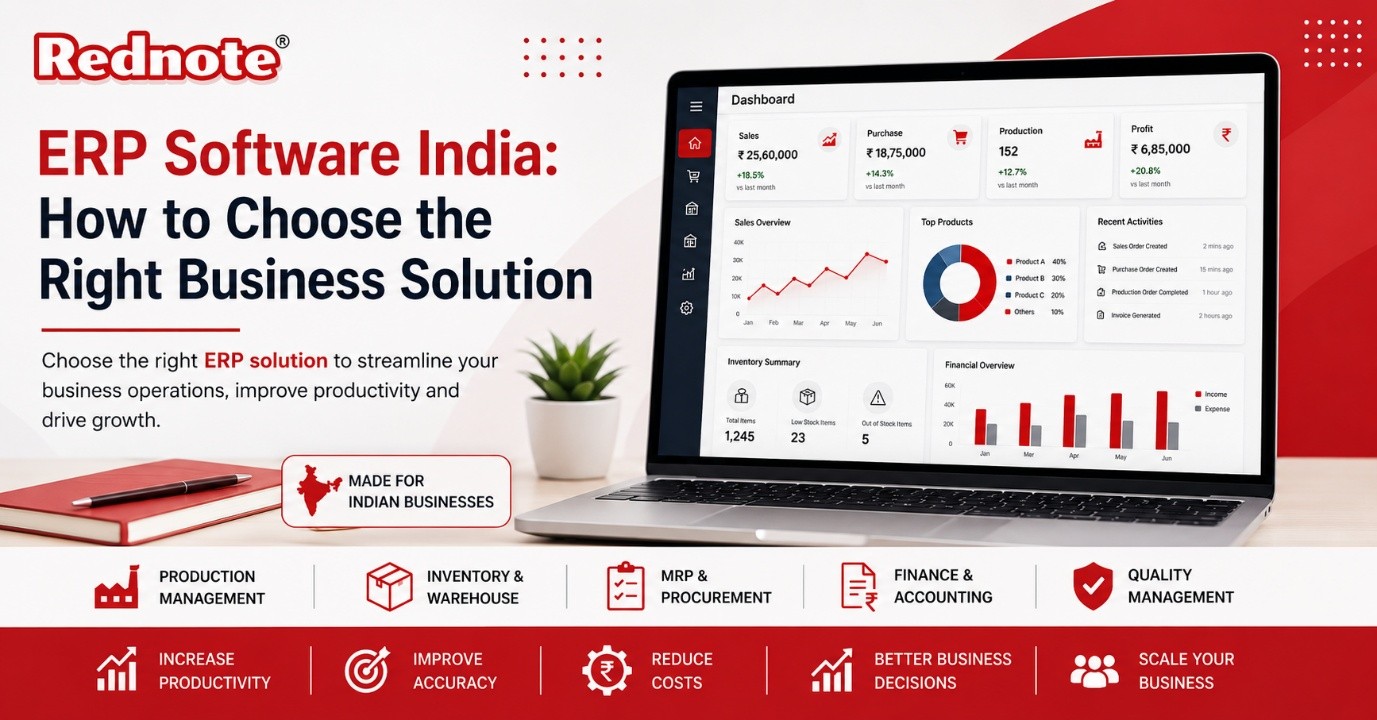
ERP Software India: How to Choose the Right Business Solution
Running a growing enterprise in today's fast-paced commercial market requires speed, accuracy, and continuous collaboration across departments. If your team is still juggling fragmented spreadsheets, disconnected accounting files, and delayed inventory updates, your operational efficiency is taking a heavy hit. Modern Indian enterprises—ranging from small and medium manufacturers to multi-location trading hubs—are rapidly upgrading their digital infrastructure. To scale seamlessly, investing in a robust ERP software India market offers is no longer a luxury; it has become an essential prerequisite for sustainable growth.
An Enterprise Resource Planning (ERP) platform acts as the central nervous system of your business. It unifies finance, sales, procurement, warehouse management, and production into a single, cohesive workflow. However, given the vast array of choices available today, picking a system that aligns perfectly with your specific operational needs and regulatory mandates can feel overwhelming. In this comprehensive guide, we will break down everything you need to know to select the right business platform, ensure compliance, and maximize your return on investment.
What is ERP Software and Why Does Your Enterprise Need It?
Instead of maintaining isolated databases for inventory, sales, procurement, and accounting, an ERP connects these functions into a real-time information network.
When a sales order is placed, a reliable ERP automatically updates raw material availability, notifies the production line, triggers purchase orders for deficient stock, and prepares tax-compliant invoicing. This high level of cross-functional automation eliminates manual data entry errors, reduces operational bottlenecks, and gives executives real-time visibility into their financial and operational health.
Key Operational Challenges Faced by Growing Enterprises in India
To understand why modern solutions are vital, it helps to look at the daily friction points businesses experience when using outdated or standalone software tools:
- Siloed Departmental Data: When sales, purchasing, and warehouse teams work on independent systems, communication gaps occur. Sales representatives might promise delivery dates without knowing actual stock availability on the warehouse floor.
- Complex GST and e-Invoicing Compliance: Regulatory requirements in India demand strict adherence to tax standards, including real-time e-invoicing and e-way bill generation for moving goods across state lines.
- Inaccurate Material Planning: Manufacturing and distribution businesses frequently face stockouts or excess holding costs due to poor Material Requirement Planning (MRP).
- Lack of Production Visibility: Tracking sub-assembly stages, batch/lot numbers, quality check parameters, and subcontracting workflows manually leads to expensive delays and wastage.
Implementing a targeted digital solution helps eliminate these structural bottlenecks directly at their source.
Essential Features to Look for in Modern ERP Software
When evaluating solutions for your organization, ensure the system goes beyond basic bookkeeping to provide end-to-end operational control. Here are the non-negotiable features your system should include:
1. Material Requirement Planning (MRP) & Procurement
A strong system automatically calculates raw material requirements based on active Sales Orders or Bills of Materials (BOM). It helps your procurement team check stock availability instantly and raise Purchase Orders (POs) with a single click when inventory falls below critical levels.
2. Multi-Warehouse & Shelf-Level Management
For growing businesses with multiple storage facilities, tracking inventory across locations is vital. Look for software that supports infinite warehouses with shelf-level detail, batch numbers, serial tracking, and reverse tracing for complete stock auditability.
3. Integrated Quality Control (QC)
Product quality determines customer satisfaction and brand reputation. Your business management suite should feature parameter-based and quantity-based inspection workflows during Goods Receipt Notes (GRN) and production runs.
4. Seamless Accounting Integration & Tax Compliance
Tax compliance shouldn't add to your daily operational strain. Look for solutions that feature direct e-Invoicing capabilities synchronized with government portals, alongside seamless integration options for popular accounting platforms like Tally to keep financial records updated automatically.
5. Multi-Operation Subcontracting
Many manufacturing setups outsource specific processing operations. A functional ERP software system simplifies subcontracted item movement, raw material issuing, and vendor performance reporting so you maintain end-to-end control over third-party workflows.
6. Dynamic Approval Workflows & Production Costing
Maintain strict operational discipline by configuring customized approval hierarchies for purchase requisitions, price overrides, and credit limits. Concurrently, precise unit costing calculations—factoring in direct labour, raw materials, and factory overheads—help protect your profit margins.
Cloud vs. On-Premise: Choosing the Right Deployment Strategy
Selecting the right architecture depends entirely on your enterprise structure, budget, data policies, and IT resources.
- Cloud ERP Solution: Hosted on secure cloud servers, a cloud-based system allows your team to access real-time operational data from anywhere via mobile or web interfaces. It minimizes upfront infrastructure expenses, eliminates local server maintenance, and offers predictable subscription pricing.
- On-Premise ERP Solution: Installed directly on your company’s internal hardware, this approach provides absolute control over data hosting. It is well-suited for companies with strict internal compliance policies or those seeking custom white-label capabilities.
Platforms like RedNote ERP cater to both preferences, offering scalable cloud platforms as well as customizable on-premise deployments designed for local operational demands.
Step-by-Step Selection Framework: How to Pick the Best ERP Software
Finding the right software involves a deliberate evaluation of your workflows and growth strategy. Follow this structured roadmap to make an informed choice:
Step 1: Map Your Core Pain Points
Bring together key department heads—finance, sales, supply chain, production, and warehouse management. Document current operational friction points, such as slow order processing times, inventory discrepancies, or delayed billing cycles.
Step 2: Establish a Clear Budget & ROI Goal
Calculate both direct costs (software licensing, custom development, hardware requirements) and indirect implementation costs (training time, data migration). Frame your decision around quantifiable ROI metrics, such as a 20% reduction in holding costs or faster invoice-to-cash turnaround.
Step 3: Evaluate Industry-Specific Functionality
Generic solutions often require expensive custom development. Choosing domain-focused systems—such as specialized manufacturing and supply chain platforms—ensures built-in support for complex Bill of Materials (BOM) configurations, batch tracking, and production order processing.
Step 4: Verify Integration and Mobility Features
Your system must integrate seamlessly with existing workflows. Check if the software offers ready integration options for third-party tools like Tally, features native mobile applications (iOS and Android) for remote management, and simplifies routine tasks like e-way bill generation.
Step 5: Test Real-World Support and Implementation Agility
Software is only as good as its implementation and ongoing support. Partner with providers that offer hands-on user onboarding, clear SLA commitments, and accessible customer support teams (such as structured phone and email assistance Monday through Saturday) to keep operations running smoothly.
Why RedNote ERP Stands Out for Indian Enterprises
When selecting the Best ERP software tailored for Indian operations, RedNote ERP delivers a comprehensive feature set crafted for modern manufacturing and distribution setups. RedNote bridges the gap between high-end enterprise tools and user-friendly software interfaces.
Core Strengths of RedNote ERP:
- End-to-End Sales & Order Tracking: Track production status in real time tied directly to customer Sales Order numbers.
- 1-Click e-Invoicing & Tally Synchronization: Generate compliant e-Invoices instantly while keeping ledger details aligned with your Tally setup.
- Granular Multi-Warehouse Control: Manage unlimited storage facilities right down to individual shelf numbers, serial lot tracking, and reverse traceability.
- Flexible Deployment Options: Available as a low-overhead cloud subscription or fully scalable on-premise installation with white-label options.
- Dedicated Local Onboarding: Backed by structured onboarding assistance and responsive customer service to ensure a smooth operational transition.
The Path to Digital Transformation
Selecting a new management solution is not just an IT upgrade—it is a strategic decision that drives efficiency, accuracy, and profitability across every department. By choosing a flexible, regulatory-compliant ERP software India businesses trust, you give your management team the clear data visibility needed to outpace competitors and respond quickly to market changes.