


ERP System: How It Helps Businesses Manage Multiple Departments
Running a growing business often feels like managing several independent companies under a single roof. The sales team chases orders, procurement struggles to stock materials, the production line runs on outdated estimates, and the finance department works endlessly to reconcile discrepancies. When information lives in isolated silos, communication breaks down, errors accumulate, and operational delays become routine. Implementing a modern ERP system provides a unified solution to these operational headaches by linking every core business function into a single, real-time database. Whether you are scaling a regional manufacturing facility or managing multi-location supply chains, centralized enterprise software brings clarity, speed, and efficiency to every corner of your enterprise.
The Core Problem: Why Siloed Departments Stifle Business Growth
Before exploring solutions, it helps to understand why unintegrated business models fail as companies scale. In traditional setups, departments often select software tailored strictly to their immediate tasks. Sales relies on standalone spreadsheets or isolated CRMs, warehouse managers track inventory manually, and accountants record transactions in separate ledgers.
While this setup may work for a small startup, growing companies quickly run into severe bottlenecks:
- Data Redundancy and Duplication: The same customer or item details get re-entered manually into multiple systems, increasing error rates.
- Delayed Decision-Making: Department leaders spend days collecting and verifying reports rather than executing operational strategy.
- Mismatched Inventory and Order Tracking: Sales reps promise rapid fulfillment without visibility into true raw material stock or active production schedules.
- Financial Discrepancies: Closing monthly financial statements takes weeks because invoices, purchase orders, and delivery receipts fail to match.
To break down these barriers, forward-thinking organizations turn to Rednote to implement intuitive management tools that centralize operations, connect teams, and eliminate everyday friction.
What Is an ERP System and How Does Centralization Work?
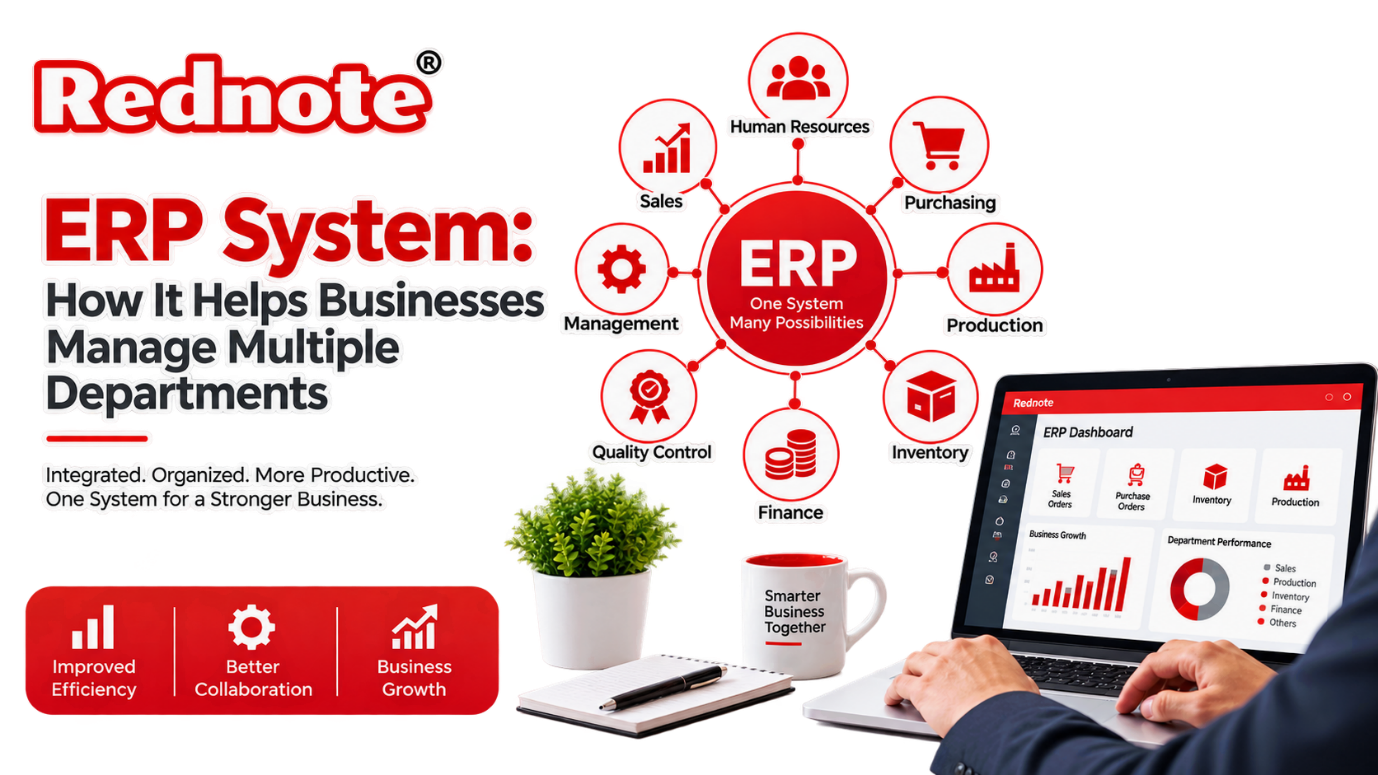
An Enterprise Resource Planning architecture acts as the central engine of your organization. Instead of maintaining distinct software tools across sales, inventory, production, human resources, and accounting, enterprise platforms consolidate all functions onto a shared database.
When one department inputs or modifies information, that data updates instantly across the entire company network. For example, when a client signs a sales agreement, the platform triggers automated notifications for every connected team:
- Procurement checks material requirements automatically to verify stock levels.
- Production schedules a new work order based on line capacity and resource availability.
- Warehouse Management reserves the necessary components for manufacturing.
- Finance schedules down-payment billing and updates revenue projections instantly.
This automated synchronization eliminates manual handoffs, removes guesswork, and allows every department to operate from a single source of truth.
Key Ways an ERP System Streamlines Multi-Department Workflows
Connecting disparate teams requires powerful features designed to bridge functional gaps. Here is how modern enterprise platforms align operations across critical departments.
1. Connecting Sales and Warehouse Operations
Sales teams need reliable stock data to close deals confidently. Without unified visibility, sales managers risk committing to orders that warehouses cannot fulfill promptly.
Integrated enterprise tools solve this gap by providing real-time inventory tracking across multiple physical storage locations, warehouses, and shelf spaces. When a sales order is created, available inventory is reserved automatically. If stock levels fall below safety thresholds, system alerts notify purchasing teams before fulfillment dates are impacted.
2. Bridging Procurement and Material Requirement Planning (MRP)
Purchasing raw materials without clear visibility into customer demand leads to tied-up capital or costly production delays.
Through integrated Material Requirement Planning (MRP), procurement managers evaluate live sales orders and active Bill of Materials (BOM) formulas with a single click. If component stock falls short, purchase orders are auto-generated and routed to designated vendors. This automated handoff ensures production schedules stay on track while keeping inventory carrying costs minimal.
3. Synchronizing Production Management and Quality Control
Manufacturing lines depend on precise sequencing, accurate lot tracking, and consistent quality checks.
When raw materials arrive at the warehouse, an enterprise ERP system supports systematic parameter-based and quantity-based inspections during Goods Receipt Notes (GRN). Once materials pass inspection, production orders convert components into finished goods using unique batch numbers. Quality teams perform line checks at designated stages, ensuring sub-standard products are caught early without delaying the entire production run.
4. Aligning Delivery, Invoicing, and Accounting
The sales lifecycle ends only when products reach customers and payments are collected. Manual handoffs between dispatch teams and accounting departments often cause billing errors and delayed collections.
Once production completes, generating a Delivery Challan (DC) automatically updates stock levels and triggers invoice generation. Modern solutions support automated e-Invoicing, sync seamlessly with third-party platforms like Tally, and keep general ledgers up to date without duplicate data entry.
Operational Advantages Across Essential Departments
| Department | Traditional Challenges | Integrated ERP Advantage |
|---|---|---|
| Sales & CRM | Unclear delivery timelines; manual order logging. | Real-time stock visibility; instant order creation and status tracking. |
| Procurement & MRP | Emergency ordering; excess inventory holding costs. | Automated stock availability checks against BOMs; automated PO generation. |
| Production & Shop Floor | Bottlenecks; manual lot tracking; resource idle time. | Batch/lot tracking; real-time work-order monitoring; accurate production costing. |
| Warehouse & Logistics | Lost inventory; misplaced items across shelf locations. | Multi-warehouse management; exact shelf-level tracking; automated DC generation. |
| Finance & Management | Delayed monthly closes; manual invoice reconciliation. | Integrated e-Invoicing; Tally synchronization; automated cost calculations. |
Crucial Features to Look For When Scaling Operations
Choosing the right enterprise software dictates how smoothly your organization transitions to unified management. To ensure complete departmental harmony, verify that your platform includes these essential capabilities:
Flexible Approval Systems and Workflows
Hierarchical approval structures keep teams accountable without creating bottlenecks. Configurable approval rules let department leads review and authorize high-value purchase orders, custom price quotes, or specialized production requests directly within the platform.
Batch and Serial Number Tracking with Reverse Tracing
Traceability is critical for industries like manufacturing, chemicals, electronics, and consumer goods. Robust tracking features assign batch numbers to incoming raw materials and follow them through processing to finished goods dispatch. If a quality issue arises, managers can perform reverse tracing instantly to isolate affected batches.
Subcontracting Management
Many businesses outsource specialized operational steps—such as heat treatment, custom coating, or specialized assembly—to external partners. An effective ERP system tracks material issued to subcontractors, monitors processing costs, and manages incoming finished items while maintaining tight control over total unit costs.
Accurate Production Costing
Calculating true unit cost requires incorporating raw material expenses, direct labor, utility overheads, and third-party processing fees. Enterprise platforms aggregate these expenses automatically, giving finance teams clear insights into gross margins and pricing strategies.
Why Modern Cloud Architecture Is the Right Choice for Growing Businesses
Traditional enterprise platforms often required heavy on-premise servers, dedicated maintenance staff, and tedious manual updates. Today's modern, cloud-enabled platforms change that equation completely.
Deploying on the cloud gives managers and operational leads secure, real-time access from desktop devices or mobile apps (Android and iOS). Field sales agents can log quotes on the go, plant managers can check line productivity remotely, and executives can analyze business metrics anytime. For companies with strict data governance mandates, options for on-premise deployment or custom white-label setups offer total flexibility.
Choosing robust solutions built by Rednote ensures your teams get an intuitive interface, effortless integration with existing accounting workflows, and responsive ongoing technical support during implementation and expansion.
Driving Sustainable Growth Through Departmental Harmony
Scaling a business does not require adding administrative complexity or hiring bloated management layers. Instead, sustainable growth comes from improving internal communication, eliminating operational redundancies, and speeding up business cycles.
By implementing an intuitive ERP system, you give every department the exact tools they need while maintaining complete centralized control. From initial lead capture to final delivery challans and e-Invoices, connected enterprise software turns isolated departments into a synchronized, high-performance organization.