



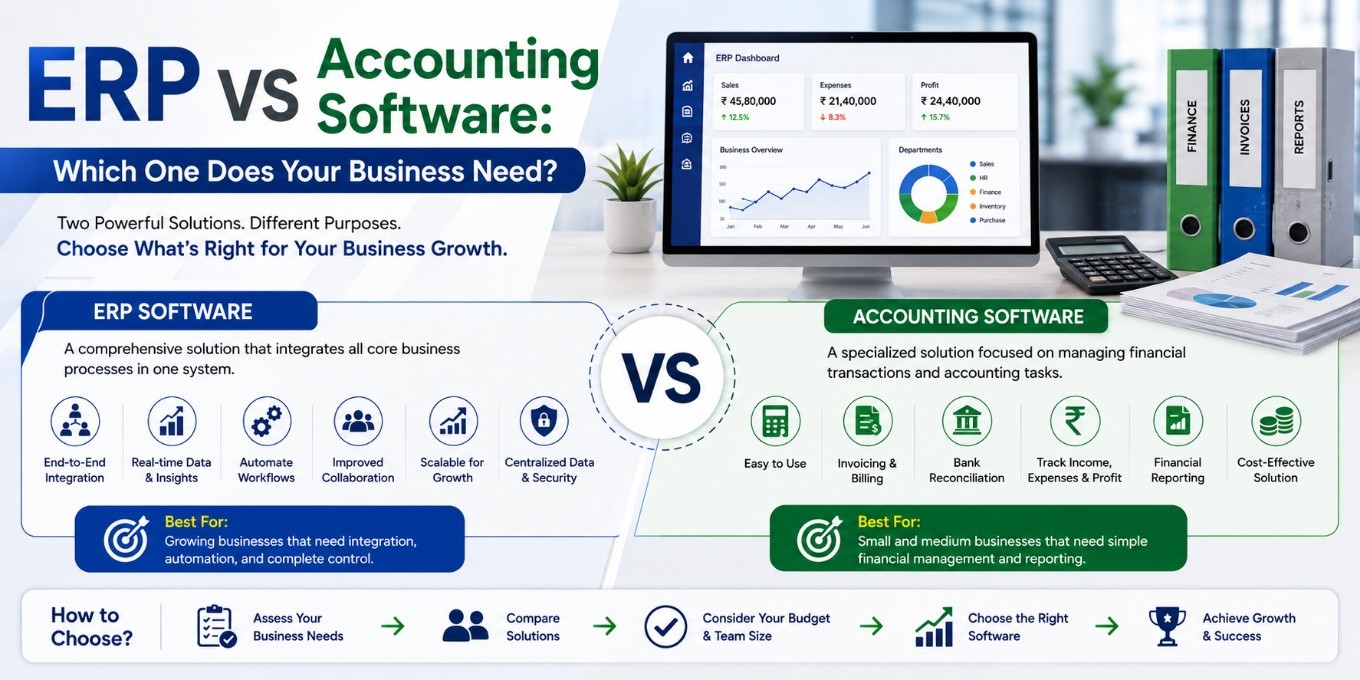
ERP vs Accounting Software: Which One Does Your Business Need?
Choosing the right business software can make a major difference in how efficiently a company operates. Many businesses start with accounting software because managing invoices, expenses, payments, and financial records is one of their first technology needs. But as the business grows, managing finance alone may no longer be enough.
This is where ERP software comes into the picture.
ERP, or Enterprise Resource Planning software, connects multiple business functions through a centralized system. Depending on the solution, it can manage finance, inventory, purchasing, sales, human resources, manufacturing, customer information, projects, and other operational processes.
Accounting software, on the other hand, is primarily designed to manage financial activities and accounting records.
So, which one does your business need?
The answer depends on your business size, operational complexity, number of departments, growth plans, and the level of integration you require. Understanding the difference between ERP and accounting software can help you make a more informed technology investment.
What Is Accounting Software?
Accounting software is designed primarily to help businesses manage their financial transactions and accounting processes.
Typical accounting systems help businesses record income and expenses, create invoices, track payments, reconcile accounts, manage taxes, and generate financial reports.
For small businesses with relatively simple operations, accounting software can provide everything needed to maintain accurate financial records without the complexity of a larger business management platform.
Common Features of Accounting Software
Depending on the product, accounting software may include:
- Invoicing and billing
- Expense tracking
- Accounts payable
- Accounts receivable
- Bank reconciliation
- Tax management
- Financial reporting
- Profit and loss statements
- Balance sheets
- Cash-flow tracking
- Payment management
- Basic payroll capabilities
The main focus is financial management.
For example, a small consulting company with a few employees and straightforward operations may only need accounting software to manage invoices, expenses, payments, and financial reporting.
What Is ERP Software?
ERP software takes a broader approach to business management.
Instead of managing only accounting activities, an ERP system can bring several departments and business processes together on a single platform.
A typical ERP system may connect finance with inventory, purchasing, sales, human resources, manufacturing, customer management, and other operational functions.
The key advantage is that departments can work with connected information instead of maintaining separate systems and spreadsheets.
Common ERP Modules
Depending on the ERP platform and business requirements, modules can include:
- Financial management
- Inventory management
- Procurement
- Sales management
- Customer management
- Human resource management
- Manufacturing
- Supply chain management
- Project management
- Warehouse management
- Reporting and analytics
- Business intelligence
For example, when a sales order is created, an integrated ERP system may update inventory, create relevant financial records, trigger purchasing requirements, and provide management with updated information.
This reduces the need for employees to enter the same information into multiple systems.
ERP vs Accounting Software: Key Differences
Although both solutions can include financial management features, their purpose is different.
| Feature | Accounting Software | ERP Software |
|---|---|---|
| Primary Purpose | Financial management | Complete business management |
| Accounting | Core feature | Core module |
| Invoicing | Yes | Yes |
| Expense Management | Yes | Yes |
| Inventory | Basic or limited | Advanced |
| Procurement | Limited | Integrated |
| Sales Management | Limited | Integrated |
| HR Management | Usually limited | Often available |
| Manufacturing | Rare | Common in suitable ERP systems |
| Supply Chain | Limited | Advanced |
| Department Integration | Limited | Strong |
| Business Reporting | Financial-focused | Cross-department reporting |
| Scalability | Suitable for simpler businesses | Designed for growing and complex operations |
| Data Centralization | Mainly financial data | Multiple business functions |
| Customization | Usually moderate | Often extensive |
The biggest difference is scope.
Accounting software focuses on the financial side of a business, while ERP software aims to connect and manage the wider organization.
When Should a Business Choose Accounting Software?
Accounting software may be the better choice if your business has relatively simple operations.
It can be suitable for businesses that:
- Have a small team
- Mainly need financial management
- Have limited inventory requirements
- Do not have complex supply chains
- Have few operational departments
- Do not need advanced workflow automation
- Are primarily focused on invoicing and expenses
- Want a simple and affordable solution
For example, freelancers, consultants, small agencies, independent professionals, and small service businesses may not need a complete ERP platform.
If the main requirement is to manage income, expenses, invoices, payments, and financial reports, an accounting system can be sufficient.
When Should a Business Choose ERP Software?
ERP software becomes more valuable when business operations become interconnected and difficult to manage through separate systems.
An ERP system may be appropriate when your business:
- Has multiple departments
- Manages significant inventory
- Operates multiple locations
- Has complex purchasing processes
- Needs real-time business data
- Has manufacturing operations
- Requires supply chain management
- Wants centralized customer and sales information
- Uses multiple disconnected software systems
- Relies heavily on spreadsheets
- Is experiencing rapid growth
For example, imagine a distribution company managing sales through one application, inventory in spreadsheets, purchasing through email, and accounting through separate software.
Employees may need to enter the same information multiple times. This can create duplicate records, delays, and errors.
An ERP system can connect these processes.
When departments use a centralized system, management can get a clearer view of what is happening across the business.
Cost: ERP vs Accounting Software
Cost is another important consideration.
Accounting software is generally less expensive because it focuses on a narrower set of business functions. Many accounting products also offer subscription-based plans designed for small businesses.
ERP software typically requires a larger investment because it covers more business processes and may require implementation, customization, data migration, employee training, and ongoing support.
However, businesses should not compare the two systems based only on their initial price.
The real question is:
What business problem is the software solving?
A low-cost accounting system may become expensive indirectly if employees spend hours transferring information between systems.
Likewise, an ERP system may provide strong value if it reduces manual work, improves operational visibility, and eliminates multiple disconnected applications.
Integration and Data Management
One of the biggest advantages of ERP software is integration.
In a business using separate systems, information may be stored in different places. Sales data could exist in a CRM, inventory data in spreadsheets, purchasing data in email, and accounting information in financial software.
This creates data silos.
Employees may have difficulty finding the latest information, while managers may struggle to create accurate reports.
ERP software aims to create a centralized environment where different departments can work with connected data.
This can improve:
- Data accuracy
- Reporting
- Collaboration
- Workflow visibility
- Decision-making
- Operational efficiency
Accounting software can integrate with other applications too, but its primary purpose remains financial management.
ERP vs Accounting Software for Business Growth
Business growth is an important factor when selecting software.
A company that starts with five employees may eventually grow to 50 or 500 employees. As operations become more complex, software requirements also change.
For a small business, accounting software may be enough initially.
However, growth can introduce new requirements such as:
- More employees
- Multiple departments
- Larger inventory
- More suppliers
- Multiple warehouses
- Complex purchasing
- More customers
- Multiple branches
- Advanced reporting
- Automated workflows
At this stage, an ERP system can provide a more scalable foundation.
That does not mean every growing company must immediately move to ERP. Businesses should evaluate their operational complexity and future requirements before making the transition.
Which Is Better for Small Businesses?
There is no universal answer.
For a small business with simple financial requirements, accounting software may be the most practical option.
For a small but operationally complex business, an ERP system may provide greater value.
For example:
Small service agency: Accounting software may be sufficient.
Small manufacturing company: ERP software may be more appropriate because production, inventory, purchasing, and finance need to work together.
Growing retail business: ERP may become valuable when inventory, purchasing, sales, warehouses, and financial operations become difficult to manage separately.
The right choice depends on the business model rather than simply the number of employees.
Signs Your Business Has Outgrown Accounting Software
Your business may be ready to consider ERP software if you regularly experience problems such as:
1. Too Many Spreadsheets
If employees constantly use spreadsheets to fill gaps between different systems, it may indicate that your current software environment is not integrated enough.
2. Duplicate Data Entry
Entering customer, order, inventory, or financial information multiple times increases the risk of mistakes.
3. Delayed Reports
If management needs several days to collect information from different departments before making decisions, centralized data could improve visibility.
4. Inventory Problems
Stockouts, excess inventory, inaccurate stock levels, or difficulty tracking inventory across locations can signal the need for stronger inventory management.
5. Disconnected Departments
When sales, finance, purchasing, inventory, and operations work with separate systems, communication can become difficult.
6. Manual Processes
If employees spend significant time performing repetitive administrative tasks, automation may provide substantial benefits.
ERP vs Accounting Software: How to Make the Right Decision
Before selecting a solution, ask these questions:
What are our biggest operational problems?
Identify the processes that consume the most time or create the most errors.
How many departments need to use the system?
If only the finance team needs the software, accounting software may be enough. If several departments need connected workflows, ERP deserves consideration.
How complex is our inventory?
Businesses with multiple warehouses, product variations, purchasing requirements, or stock movements may benefit from ERP capabilities.
Are we planning to grow?
Consider your expected business size and operational complexity over the next three to five years.
How much automation do we need?
If your goal is to automate workflows across departments, ERP may be more suitable.
What is our total cost of ownership?
Consider licensing, implementation, customization, training, support, integrations, and employee time—not just the monthly subscription.
ERP vs Accounting Software: Which One Does Your Business Need?
The decision can be summarized simply:
Choose accounting software if:
Your primary requirement is managing financial transactions, invoicing, expenses, payments, taxes, and financial reporting.
Choose ERP software if:
Your business needs to connect finance with inventory, sales, purchasing, HR, manufacturing, supply chain, projects, or other operational functions.
For many small businesses, accounting software is an excellent starting point. As the organization grows and processes become more interconnected, ERP software can provide the centralized infrastructure needed to manage that complexity.
The best solution is not necessarily the one with the most features. It is the one that solves your current problems while supporting your future business goals.
ERP and accounting software serve different purposes, even though both can handle financial information.
Accounting software is a focused solution for managing finances, making it an excellent choice for businesses with straightforward accounting needs. ERP software provides a broader platform for organizations that need to connect multiple departments and business processes.
Before making a decision, evaluate your current operations, future growth plans, budget, integration requirements, and biggest productivity challenges.
If finance is your primary requirement, accounting software may be enough. If your entire business needs to work from connected data, ERP software may be the better long-term investment.
The goal should always be to choose technology that makes your business easier to manage—not technology that simply gives you more features.