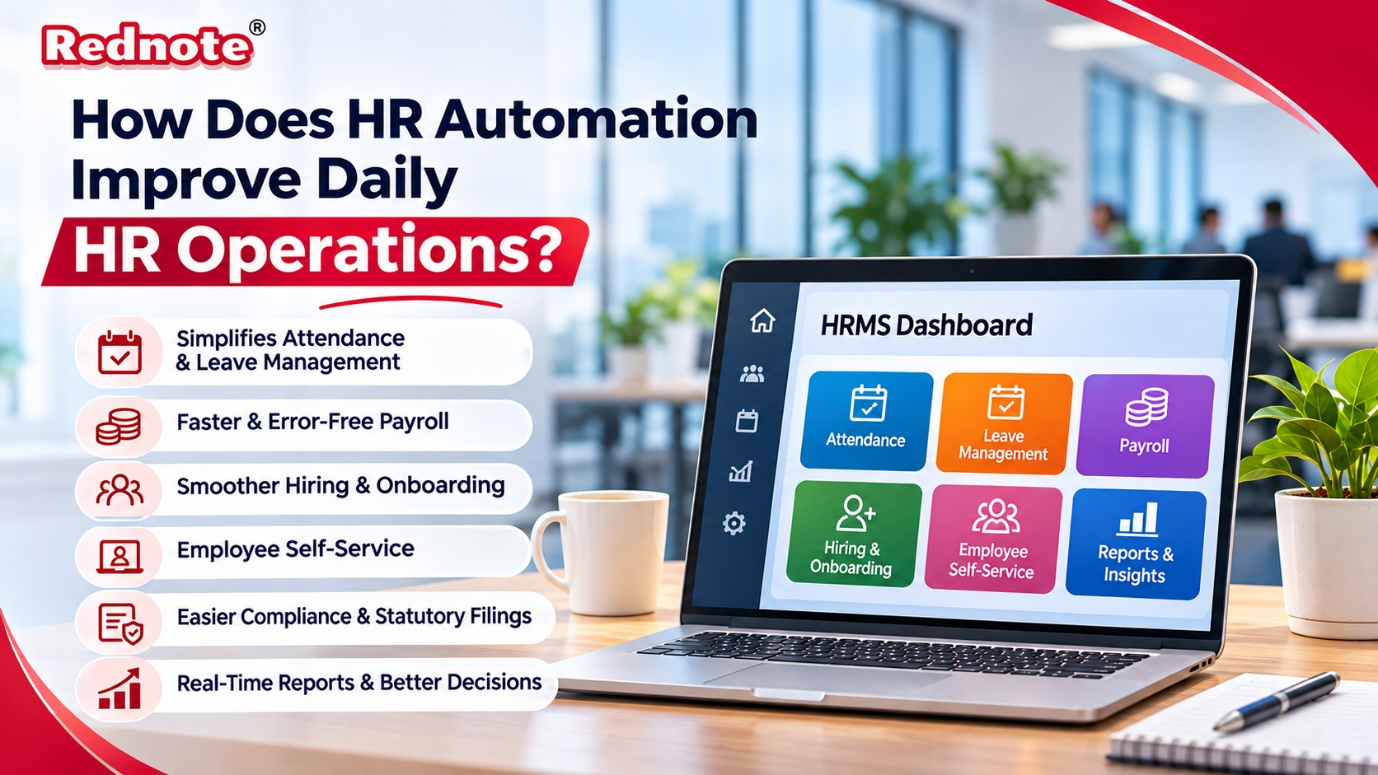
How Does HR Automation Improve Daily HR Operations?
Ask anyone in HR how their day went, and you’ll often hear the same thing: “Busy, but I didn’t get to the real work.” Chasing leave approvals, fixing attendance errors, answering the same payslip question for the fifth time, and updating spreadsheets can eat up most of the day. This is exactly the problem that modern HRMS software is built to solve. It takes the repetitive, error-prone tasks off your plate so you can spend your time on people.
Below, we’ll look at how HR automation changes the daily routine of an HR team, with practical examples you can relate to.
What Is HR Automation, Really?
HR automation means using technology to handle routine HR tasks without manual effort at every step. Instead of someone collecting data, checking it, entering it somewhere else, and then emailing a report, the system does most of that on its own.
Think of attendance. In a manual setup, an HR executive collects punch records, matches them with leave requests, and corrects mistakes by hand. With good HR software, attendance flows in automatically, leave balances update in real time, and exceptions are flagged for review. You only step in when something genuinely needs a human decision.
That is the whole idea. Machines handle the repetitive work, and people handle the judgment calls.
1. Attendance and Leave Management Becomes Painless
Attendance is one of the biggest daily headaches, especially for companies with shifts, field staff, or multiple locations. Automation helps in a few simple ways:
- Employees check in through a mobile app, biometric device, or web login.
- Late marks, half days, and overtime are calculated by preset rules.
- Leave requests go straight to the manager, who approves with one tap.
- Leave balances update immediately, so nobody has to ask HR, “How many leaves do I have left?”
The result is fewer disputes and far less back-and-forth. When the rules are applied the same way for everyone, employees also trust the process more.
2. Payroll Runs Faster and With Fewer Mistakes
If there is one area where errors really hurt, it’s salary. A wrong deduction or a missed allowance creates stress for the employee and extra work for HR. Manual calculations are slow, and every extra spreadsheet increases the chance of a mistake.
Dependable payroll software pulls attendance, leave, and overtime data directly into the salary calculation. It applies tax slabs, PF, ESI, and other statutory deductions automatically, then generates payslips in a few clicks. What used to take two or three days at month-end can often be finished in a few hours.
There’s also a quieter benefit. When employees receive accurate salaries on time, month after month, the number of payroll queries drops sharply. That alone gives HR a lot of breathing room.
3. Hiring and Onboarding Feel More Organized
Recruitment involves a lot of moving parts: job postings, resume screening, interview scheduling, offer letters, and document collection. Doing this through emails and sheets means things slip through the cracks.
Automation helps by:
- Posting jobs and collecting applications in one place
- Sending interview invites and reminders automatically
- Generating offer letters from templates
- Collecting joining documents digitally before the first day
Onboarding gets easier too. The new hire fills in their details once, and that information moves to attendance, payroll, and the employee record without anyone retyping it. On day one, they have their login, their policies, and a clear task list, which makes a much better first impression.
4. Employee Self-Service Reduces Repetitive Questions
Many HR queries are simple and repeat all the time. “Can I get my payslip?” “What’s my leave balance?” “How do I update my address?” Each one takes only a minute, but together they can fill hours of the week.
A self-service portal lets employees find these answers themselves. They can download payslips, apply for leave, view their attendance, update personal details, and read company policies at any time, even on a weekend. HR is no longer the bottleneck for basic information, and employees appreciate not having to wait for a reply.
5. Compliance Stops Being a Last-Minute Scramble
Labour laws, statutory filings, and audits are non-negotiable, and keeping up manually is stressful. Rules change, deadlines are tight, and one missed filing can mean penalties.
Automation lowers that risk. The system stores records in an organized way, calculates statutory contributions correctly, and reminds you before due dates. When an auditor asks for a document, you can find it in seconds instead of digging through folders and old emails.
An integrated HR payroll software setup is especially useful here, because attendance, salary, and compliance data all live in one place. There’s no mismatch between what HR recorded and what finance processed.
6. Reports and Insights Are Available When You Need Them
Leadership often asks questions like, “What’s our attrition this quarter?” or “How much are we spending on overtime?” Without automation, answering takes days of data gathering, and by then the numbers may be outdated.
With automated reporting, you get live dashboards and ready-made reports on headcount, absenteeism, payroll costs, and hiring progress. This lets HR walk into a meeting with real numbers instead of estimates. Over time, those patterns also help you spot problems early, such as a department with unusually high leave or a team with a rising exit rate.
7. Employee Experience Quietly Improves
Employees may never say, “Thank you for automating my leave process,” but they notice the difference. They get paid correctly, their requests are handled quickly, and they don’t have to chase anyone for basic things.
That smoothness adds up. Good experiences with small, everyday processes make people feel valued, and that supports retention. Meanwhile, HR gets to do the meaningful work: coaching managers, planning training, improving culture, and resolving real employee concerns.
How to Get Started Without Overwhelming Your Team
Moving from manual work to automation doesn’t have to happen overnight. A few practical tips:
1. Start with the biggest pain point.
For most companies, that’s attendance or payroll. Fix that first, then expand.
2. Clean up your data.
Make sure employee records, salary structures, and leave policies are accurate before you move them to a new system.
3. Involve your team.
Show managers and employees how the system will make their work easier. Adoption goes much more smoothly when people understand the benefit.
4. Choose a flexible solution.
Your business will grow and change, so pick something that can scale with you and adapt to your policies.
5. Train people properly.
A short walkthrough at the start saves a lot of confusion later.
If you’re exploring solutions, the team at Rednote.in can help you understand what fits your company size and needs, without pushing you toward features you won’t use.
Final Thoughts
HR automation isn’t about replacing people. It’s about removing the repetitive tasks that keep good HR professionals from doing their best work. Attendance gets tracked accurately, salaries are processed on time, onboarding feels organized, compliance stays under control, and decisions are backed by real data.
If your team is still stuck in spreadsheets and email chains, now is a good time to make the switch. A reliable HRMS software can give you hours back every week and help your business run more smoothly. To see how it could work for your company, get in touch with Rednote.in today.