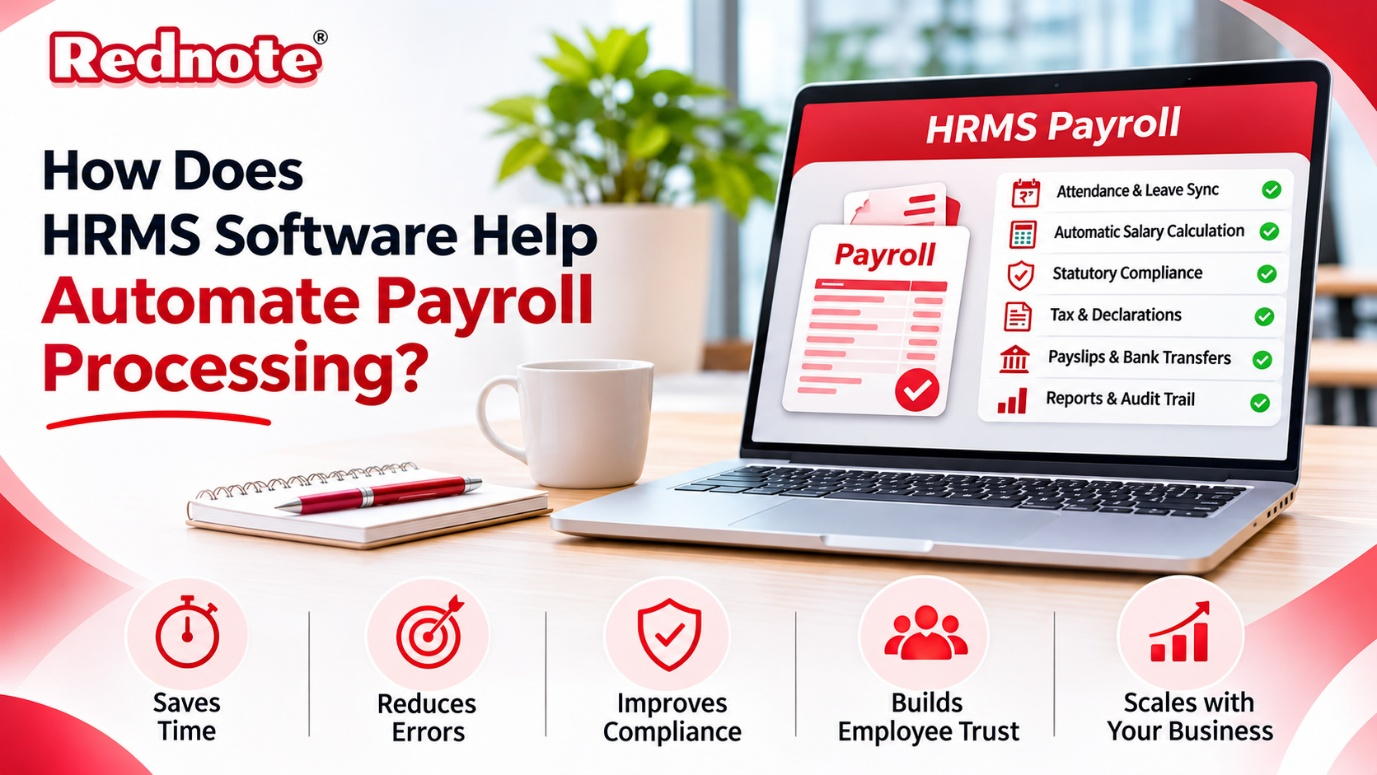
How Does HRMS Software Help Automate Payroll Processing?
If you have ever spent the last three days of a month chasing attendance sheets, fixing formula errors in Excel and answering “why is my salary short?” messages, you already know how painful manual payroll can be. Many growing businesses are now moving to HRMS software Chennai to take that burden off their HR and finance teams. Payroll is one of the first processes they automate, because it is repetitive, rule-based and unforgiving when something goes wrong.
This blog explains how an HRMS (Human Resource Management System) automates payroll end to end, what you gain from it, and what to check before you pick a tool.
What Is Payroll Processing, and Why Is It So Hard to Get Right?
Payroll is more than transferring salary on the last day of the month. For each employee, someone has to:
- Collect attendance, leave and overtime data
- Calculate earnings such as basic pay, HRA, allowances and incentives
- Apply deductions such as PF, ESI, professional tax and TDS
- Add reimbursements, loans and advances
- Generate payslips and bank transfer files
- File statutory returns on time
Each step depends on the one before it. A single wrong leave entry can change the net pay, the tax deducted and the PF contribution. When this runs on spreadsheets, errors are almost guaranteed as the headcount grows. A company with 20 employees might manage. At 100 or 300, it becomes a monthly firefight.
How HRMS Software Automates Payroll Processing
Here is how a good HRMS handles each stage.
1. Attendance and Leave Sync
The biggest source of payroll errors is bad attendance data. An HRMS connects with biometric devices, mobile check-ins, web login or shift rosters and records working hours automatically. Leave requests are approved inside the system, so approved leaves, loss-of-pay days and holidays flow straight into payroll with no manual re-entry.
The HR team no longer has to compare three different sheets to find out how many days someone worked. The system already knows.
2. Automatic Salary Calculation
You set up the salary structure once: basic, HRA, special allowance, bonus and so on. After that, the software calculates gross and net pay for every employee using the rules you defined. Mid-month joiners, resignations, salary revisions and arrears are pro-rated automatically.
This is where you save the most time. What used to take two or three days of careful checking can take a few minutes, and the figures are consistent every month.
3. Statutory Compliance Built In
Indian payroll comes with a long list of compliance requirements: Provident Fund, ESI, Professional Tax, Labour Welfare Fund and income tax deduction at source. Rates and slabs also change from time to time.
A reliable HRMS keeps these rules updated and applies them automatically. It also generates challans, ECR files and returns in the required formats. For companies in Tamil Nadu, a good HRMS software Chennai businesses can trust will handle professional tax and state-specific rules without someone watching government notifications every month.
4. Tax Calculation and Investment Declarations
Employees can submit their investment proofs and declarations through a self-service portal. The system calculates the tax liability, spreads the TDS across the year and updates it if the employee submits new proofs. At the end of the year, Form 16 and tax statements are generated in a few clicks.
This removes the year-end rush when finance teams usually scramble to reconcile hundreds of declarations.
5. Payslips and Bank Transfers
Once payroll is approved, the HRMS produces payslips for everyone and emails them or makes them available in the employee app. It also creates the bank advice file, which you can upload to your bank for bulk salary transfer. No more password-protected PDFs sent one by one.
6. Reports and Audit Trail
Need a salary register, department-wise cost report or PF summary? You can pull it out instantly. Every change in the system is logged, so during an audit you can see who changed what and when. That level of traceability is very hard to get with spreadsheets.
Key Benefits of Automating Payroll With an HRMS
Saves time. HR teams often report cutting payroll processing time by more than half. That time goes back into hiring, engagement and other work that actually needs human attention.
Reduces errors. Formulas are defined once and applied uniformly. This avoids the wrong deduction, the missed allowance or the duplicate payment that cause so many employee complaints.
Improves compliance. Automated calculations and filing reminders lower the risk of penalties for late or wrong statutory payments.
Builds employee trust. When people get correct payslips on time, every month, confidence in the company goes up. Self-service access to payslips, tax statements and leave balances also reduces the number of questions reaching HR.
Gives better financial visibility. Because payroll data sits in one place, management can forecast salary costs, track overtime trends and plan budgets with real numbers.
Scales with your business. Adding 50 new employees does not mean adding another person to the payroll team. The software handles volume without extra effort.
Common Mistakes to Avoid When Moving to Automated Payroll
Automation helps, but only if it is set up properly. Watch out for these:
- Importing messy data. Clean up employee records, bank details and salary structures before migrating. The software will faithfully repeat whatever you feed it, including mistakes.
- Skipping a parallel run. Run one or two payroll cycles in the old and new systems together and compare the results before you switch fully.
- Ignoring training. HR, finance and managers all need to know how to use the system. Even the best tool fails if people keep sending attendance through WhatsApp.
- Choosing on price alone. The cheapest option may lack compliance updates, support or integrations you will need later.
What to Look for in a Payroll-Ready HRMS
Before you sign up, check these points:
1. Compliance coverage: PF, ESI, PT, TDS and labour law updates handled automatically.
2. Attendance integration: Works with your biometric devices, mobile app or shift system.
3. Flexible salary structures: Supports multiple pay grades, variable pay, incentives and arrears.
4. Employee self-service: Payslips, tax declarations and leave on web and mobile.
5. Reporting: Ready-made and customizable reports.
6. Data security: Role-based access, encryption and regular backups.
7. Local support: Quick help from people who understand Indian payroll rules.
That last point matters more than most buyers expect. When payroll day arrives and something looks off, you want a support team that answers the phone and knows your setup. This is why many companies shortlist HRMS software Chennai vendors who offer on-ground help and understand regional compliance and business practices. A provider such as rednote.in makes onboarding and day-to-day support much smoother.
Is Payroll Automation Worth It for Small and Mid-Sized Businesses?
Yes, and often more than for large enterprises. Larger companies usually have dedicated payroll teams. A 30-person company usually has one HR person doing everything, and payroll eats a big share of their month. Automation gives that person time back and reduces the risk of a costly mistake.
If you are still unsure, ask yourself a few honest questions. Do you spend more than two days a month on payroll? Have you had salary errors in the last six months? Do you worry about missing a compliance deadline? If the answer to any of these is yes, an HRMS is likely to pay for itself quickly. Small teams in particular should look at HRMS software Chennai options with simple pricing and quick setup, so they get value from the very first cycle.
https://rednote.in/hrms-software-chennaiA Simple Payroll Workflow With an HRMS
To make this concrete, here is how a typical month looks once everything is automated:
- Employees mark attendance and apply for leave through the app.
- Managers approve leave and corrections before the cut-off date.
- HR opens the payroll cycle, reviews the pre-calculated salary sheet and checks exceptions.
- Finance approves the payroll with a click.
- Payslips are released and the bank file is generated.
- Statutory reports are downloaded and filed.
What used to be a three-day scramble becomes a few hours of review. The effort moves from calculating to checking, which is far less stressful and much more accurate.
Ready to Move Your Payroll Off Spreadsheets?
Payroll will always be sensitive, because it deals with people’s income. But it does not need to be stressful. An HRMS removes repetitive calculation, applies compliance rules consistently and gives employees clear, timely payslips. The result is a payroll process that runs smoothly and quietly in the background, which is exactly how it should work.
If your business is ready to leave spreadsheets behind, explore options for HRMS software Chennai and choose a platform that matches your size, your compliance needs and the way your team actually works. Start with a demo, test it with your own salary structure, and see the difference in your very next payroll cycle. You can also visit rednote.in to learn more.