



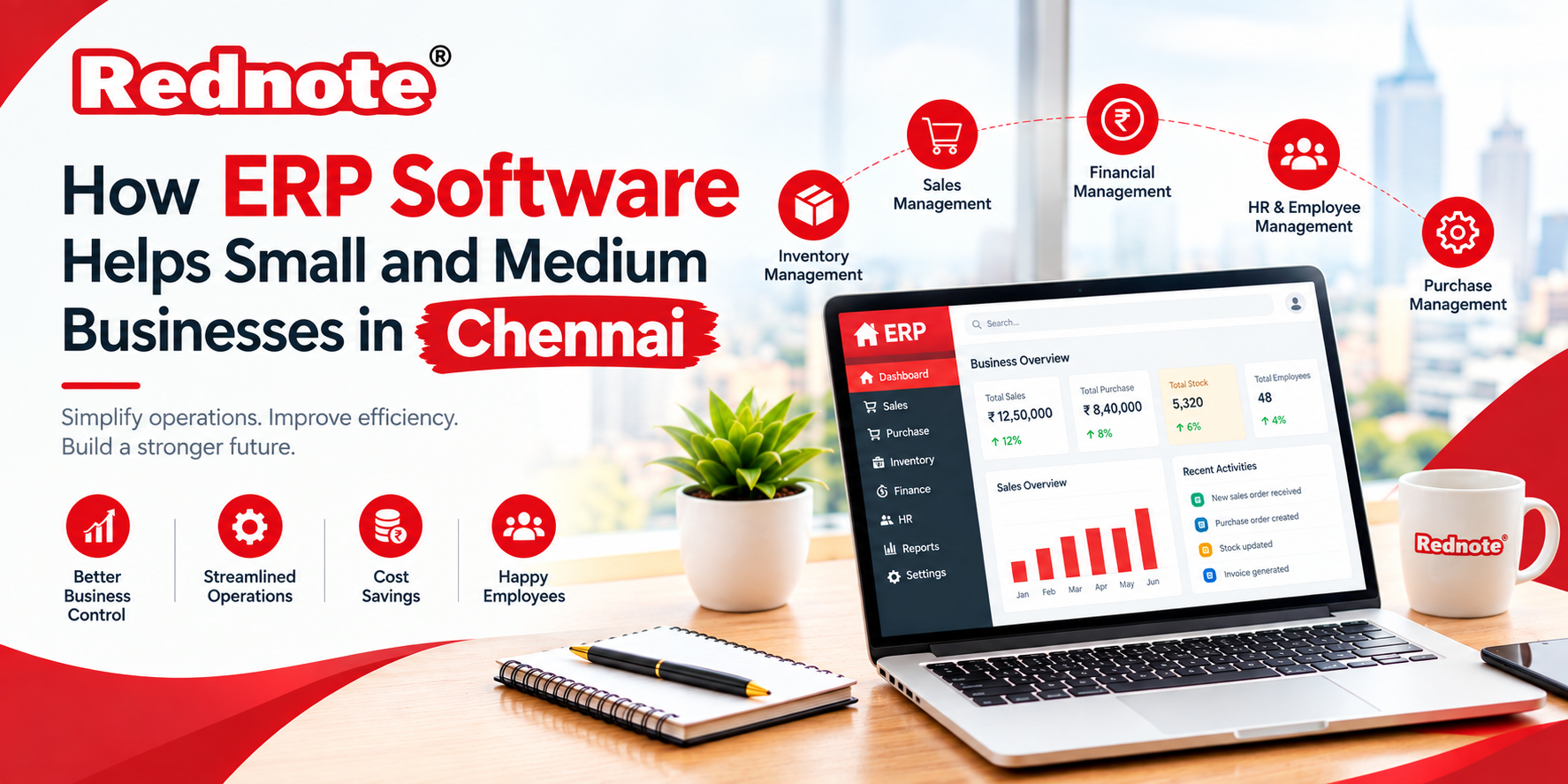
How ERP Software Helps Small and Medium Businesses in Chennai
Running a small or medium-sized business in Chennai involves managing several activities at the same time. Sales, purchasing, inventory, accounting, employee management, customer information, and daily operations all need to work together. When these activities are managed through separate spreadsheets and software, it can become difficult to maintain accurate information and keep business processes organized.
This is where ERP software in Chennai can help businesses create a more connected and structured way of managing their operations.
ERP, or Enterprise Resource Planning, software brings different business functions together through a centralized system. Instead of using separate tools for finance, sales, inventory, purchasing, and employee management, businesses can manage many of these activities through one integrated platform.
For small and medium businesses, choosing the right ERP software for SMEs in Chennai can help reduce repetitive work, improve access to business information, and support more organized growth.
What Is ERP Software?
ERP software is a business management system that connects different departments and processes within an organization. Depending on the software and business requirements, an ERP system may include modules for accounting, sales, inventory, purchasing, HR, payroll, production, customer management, reporting, and more.
For example, when a sales order is created, the system can connect the order with inventory availability and billing information. This reduces the need to enter the same information manually in different systems.
A business management software in Chennai with ERP capabilities can therefore help companies manage their daily operations from a centralized platform.
Why Do Small and Medium Businesses Need ERP?
Many growing businesses initially depend on spreadsheets and individual applications. This may work when the company has only a few employees and customers. However, as the business expands, the amount of information also increases.
Businesses may start facing challenges such as:
- Duplicate data entry
- Incorrect inventory records
- Delayed financial reports
- Difficulty tracking customer orders
- Communication gaps between departments
- Manual employee records
- Poor visibility into business performance
- Time-consuming reporting
An ERP system for small businesses can bring these processes together and provide employees with access to the information they need based on their roles.
How ERP Software Helps Chennai Businesses
Chennai has a wide range of small and medium businesses operating across manufacturing, retail, wholesale, distribution, technology, healthcare, education, logistics, and professional services.
Because every business has different operational requirements, ERP solutions can be configured according to the company's needs.
Here are some of the major ways ERP solutions in Chennai can support growing businesses.
1. Centralized Business Data
One of the main advantages of ERP is centralized data management.
Without ERP, a company may maintain sales information in one spreadsheet, inventory information in another system, and accounting records in separate software.
This can make it difficult for management to understand what is happening across the business.
An ERP platform brings relevant information together. Authorized users can access updated information according to their responsibilities.
This makes a centralized ERP system useful for businesses looking for better coordination between departments.
2. Better Inventory Management
Inventory management is an important part of operations for retailers, distributors, wholesalers, and manufacturers.
Manual inventory tracking can lead to stock discrepancies, overstocking, stock shortages, and delays in updating product information.
ERP software for inventory management can help businesses track products, stock levels, purchases, sales, and product movement from a single system.
For example, a distributor can check available stock before confirming an order. The purchase team can also use inventory information to understand when additional products may be required.
This can make inventory management more organized and reduce unnecessary manual tracking.
3. Improved Financial Management
Financial management is another important area where ERP can support small and medium businesses.
A business may have invoices, expenses, payments, receivables, and other financial information spread across different records.
With ERP software for finance management, businesses can connect financial activities with other operational processes.
Depending on the ERP system, businesses may be able to manage:
- Invoices
- Expenses
- Payments
- Accounts receivable
- Accounts payable
- Financial reports
- Transaction records
Having financial information connected with sales and purchasing activities can make it easier for management to monitor business operations.
4. Streamlined Sales Management
Sales teams need accurate customer, product, order, and payment information.
A business ERP system can connect sales activities with inventory, customer records, billing, and other business processes.
For example, when a sales representative receives an order, they can check product availability before confirming the order. The relevant information can then flow into the appropriate business processes.
This type of integration can help reduce communication gaps between sales, inventory, and finance teams.
5. Employee and HR Management
Managing employees manually can become difficult as a company grows.
ERP software for employee management can help businesses maintain centralized employee records and manage processes such as:
- Employee information
- Attendance
- Leave
- Payroll
- Departments
- Employee records
- HR administration
For medium-sized businesses, having employee information in a centralized system can make routine HR activities easier to organize.
6. Reduced Manual Data Entry
Repeated data entry takes time and increases the possibility of human error.
For example, an employee may need to enter the same customer order into a sales spreadsheet, inventory record, invoice system, and accounting software.
An integrated ERP platform can connect these processes.
This is one reason why ERP solutions for small businesses are increasingly considered when companies want to improve operational efficiency without continuously adding manual administrative work.
ERP Software vs Traditional Business Management
| Business Area | Traditional Method | ERP-Based Method |
|---|---|---|
| Sales | Separate spreadsheets | Integrated sales management |
| Inventory | Manual stock records | Centralized inventory tracking |
| Finance | Separate accounting records | Connected financial information |
| Purchasing | Manual coordination | Structured purchase workflow |
| Employees | Multiple HR files | Centralized employee management |
| Reporting | Manually prepared reports | Integrated reports and dashboards |
| Customer Data | Different records | Centralized customer information |
| Business Data | Scattered across tools | Connected through one system |
Cloud ERP Software for Chennai Businesses
Cloud ERP software in Chennai can be useful for businesses that want to access their ERP system through internet-connected devices.
A cloud-based system can provide flexibility for businesses with employees or managers working from different locations.
For example, a business owner can review selected business information remotely, while authorized employees manage sales, inventory, or finance from the office.
However, businesses should not select a cloud ERP system based only on remote access. Security, user permissions, data backup, integrations, technical support, scalability, and pricing should also be evaluated.
ERP for Different Types of Businesses
ERP software can be useful across different industries, although the required modules may vary.
Retail Businesses
Retail companies can use ERP systems to connect sales, inventory, purchasing, customer records, and financial information.
Manufacturing Companies
Manufacturers may require production planning, raw material tracking, inventory management, purchasing, and financial modules.
Distribution Businesses
Distributors can benefit from inventory, sales order, purchasing, warehouse, and customer management capabilities.
Service Businesses
Service companies may use ERP for customer management, project tracking, employee management, invoicing, and financial operations.
Growing Startups
Startups that are expanding rapidly may consider ERP when spreadsheets and separate tools become difficult to manage.
How to Choose ERP Software for SMEs in Chennai
Choosing an ERP system should begin with understanding the company's actual requirements.
Before selecting ERP software for medium businesses, consider the following factors.
Business Requirements
Identify the departments that need ERP support. For example, a business may need only finance, sales, and inventory initially.
Number of Users
Consider how many employees will use the system and what level of access each employee requires.
Required Modules
Do not select an ERP simply because it has a large number of features. Choose modules that are relevant to your business operations.
Integration
Check whether the ERP can integrate with existing accounting systems, payment gateways, CRM platforms, e-commerce websites, or other business tools.
Ease of Use
Employees should be able to understand the system without unnecessary complexity. Proper training should also be included as part of the implementation process.
Reporting
Good reporting capabilities can help management understand sales, inventory, expenses, employee information, and other business metrics.
Scalability
The ERP should be capable of supporting the business as the number of employees, customers, transactions, and products increases.
ERP Implementation in Chennai
Selecting software is only one part of the process. ERP implementation in Chennai also requires proper planning.
Businesses should consider:
- Data migration
- User access
- Employee training
- Workflow configuration
- System integration
- Testing
- Technical support
- Ongoing maintenance
Before implementation, businesses should clean outdated or duplicate information. Migrating inaccurate data into a new ERP system can create problems later.
A phased implementation may also be useful for businesses that want to introduce ERP gradually rather than changing every process at once.
Common ERP Implementation Mistakes
Businesses can face difficulties when ERP implementation is not properly planned.
Some common mistakes include choosing software only because of its low price, adding unnecessary modules, ignoring employee training, migrating poor-quality data, and failing to define clear workflows.
Another common mistake is trying to automate a process that is already inefficient.
Before automation, businesses should review the process itself. Once the workflow is clear, ERP automation can be used to reduce repetitive tasks.
Pro Tip
Pro Tip: Before choosing an ERP system, list your five biggest operational problems and identify which department is responsible for each one. Then compare ERP solutions based on how well they solve those specific problems. This makes it easier to choose useful features instead of paying for unnecessary modules.
Is ERP Software Suitable for Small Businesses?
ERP is not automatically necessary for every small business.
However, it can become useful when a company starts experiencing increasing operational complexity.
A business may consider an ERP system for SMEs when it has:
- Too many spreadsheets
- Growing customer orders
- Increasing inventory
- Multiple departments
- Repetitive data entry
- Difficulty preparing reports
- Financial tracking challenges
- Employee management requirements
The decision should depend on the company's current requirements, budget, number of users, growth plans, and operational complexity.
Benefits of Using ERP Solutions in Chennai
The main purpose of an ERP system is to make business information and processes more connected.
With the right ERP solutions in Chennai, businesses can potentially improve:
- Data visibility
- Inventory control
- Financial tracking
- Sales coordination
- Employee management
- Reporting
- Business process automation
- Departmental communication
The actual results will depend on the software selected, implementation quality, employee adoption, and how effectively the system is used.
Final Thoughts
As small and medium businesses grow, managing every process through spreadsheets and disconnected applications can become increasingly difficult.
ERP software for small and medium businesses in Chennai provides a way to connect important business functions through one centralized platform. From inventory and finance to sales and employee management, ERP can help businesses organize their processes and improve access to important information.
For companies considering ERP, the most important step is to start with their actual business requirements. Instead of choosing software simply because it has many features, businesses should identify their operational challenges and select an ERP system that addresses those needs.
With proper planning, employee training, data preparation, and implementation support, ERP can become an important part of a company's long-term business management strategy.