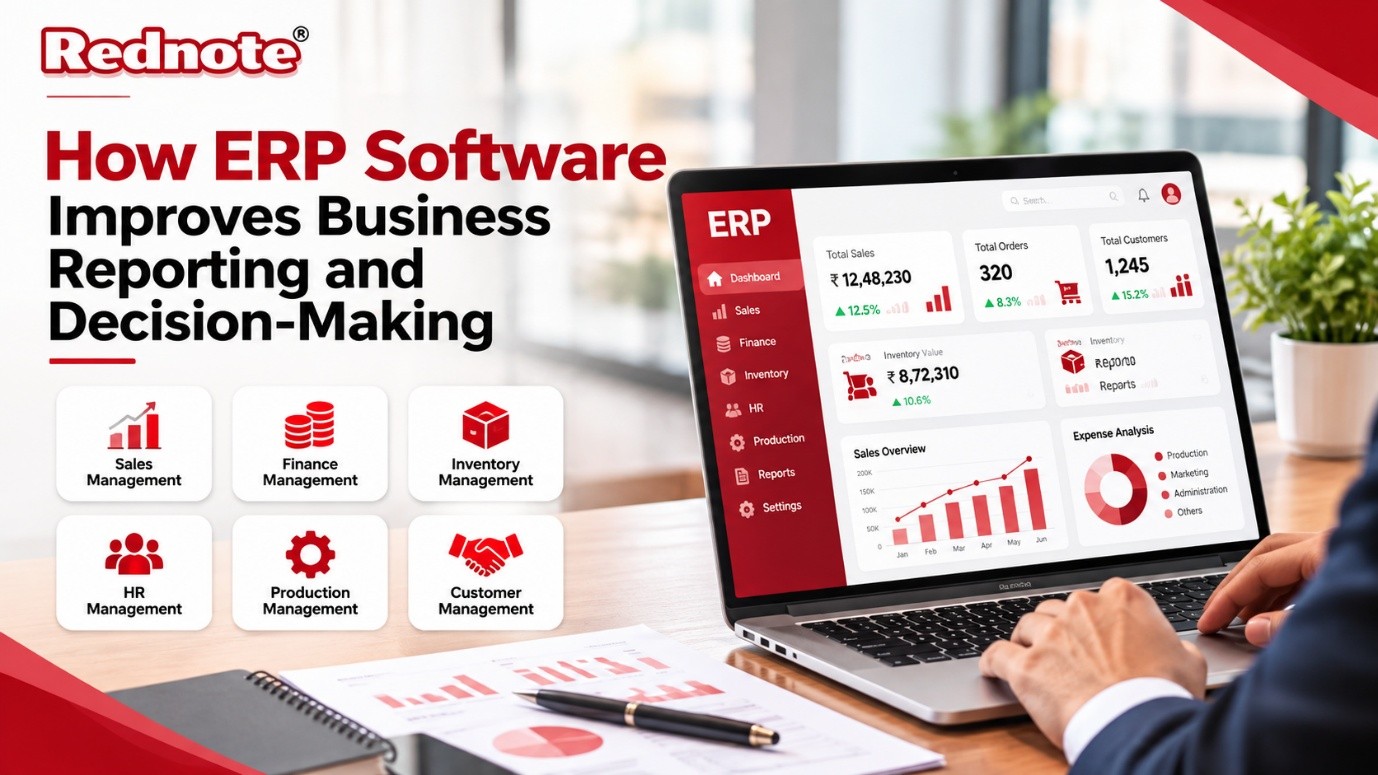
How ERP Software Improves Business Reporting and Decision-Making
Every business owner has had this moment: you need a simple number, like last month’s profit or the stock sitting in your warehouse, and it takes three people and two spreadsheets to find it. By the time the report is ready, the situation has already changed. This is why more companies now look for reliable ERP software Chennai solutions that bring sales, accounts, inventory, and HR data into one place. When your information lives in one system, reporting stops being a monthly struggle and becomes part of everyday work.
In this blog, we’ll look at how ERP software improves business reporting, how it helps managers make better decisions, and what to look for before you invest.
What Is ERP Software, in Simple Words?
ERP stands for Enterprise Resource Planning. It is a single software platform that connects the main parts of your business: finance, sales, purchasing, inventory, production, customer management, and human resources.
Without ERP, each department usually keeps its own files. Accounts use one tool, the sales team uses another, and the warehouse relies on Excel sheets. The data rarely matches, and somebody has to join it all together by hand.
With ERP, every department works from the same database. When a salesperson creates an invoice, the stock updates and the accounts entry posts at the same moment. Nobody has to copy anything twice.
The Reporting Problems ERP Solves
Most businesses that struggle with reports are not short of data. Their data is scattered, outdated, or inconsistent. Here are the common problems:
- Manual data entry: Typing the same figures into several sheets invites mistakes.
- Delayed reports: Month-end closing can take weeks when numbers must be collected from different people.
- Conflicting versions: Two managers present two different sales figures, and no one knows which is right.
- No big picture: You can see your sales or your expenses, but not how they relate to each other.
ERP software fixes these problems at the source. Because data is entered once and shared everywhere, reports are built from a single, trusted record.
How ERP Improves Business Reporting
1. Real-time data instead of old numbers
A traditional report tells you what happened last month. An ERP dashboard shows what is happening today. You can check daily sales, outstanding payments, pending purchase orders, and stock levels whenever you need them. For a business that moves fast, this alone can save lost orders and wasted cash.
2. Fewer errors and better accuracy
Manual reporting depends on people copying and pasting, and even careful people make mistakes. ERP removes most of that work. Calculations like taxes, discounts, and totals happen automatically, so your reports stay clean and dependable. When your numbers are right, you trust them, and that trust matters when big decisions are on the table.
3. Custom reports for every role
A finance head needs cash flow and receivables. A production manager needs material usage and machine output. The owner wants a quick overview of everything. A good ERP system lets each person see the reports that matter to them, without asking the IT team for help each time.
4. Faster month-end and year-end closing
Closing the books is often the most stressful time for an accounts team. Since ERP keeps transactions updated daily, much of the work is already done by the time the month ends. Many companies cut their closing time from weeks to a few days.
5. Easier compliance and audits
Tax filings, GST reports, and audit documents all need accurate records. ERP keeps a clear trail of every transaction, who made it, and when. When an auditor or tax officer asks a question, you can answer in minutes rather than digging through old files.
How Better Reports Lead to Better Decisions
Reports are only useful if they help you act. Here’s how ERP turns information into smarter choices.
You spot trends early. If a product’s sales have been slowly dropping for three months, an ERP report shows it clearly. You can adjust pricing, run a promotion, or change your purchase plan before the problem grows.
You control costs with confidence. When you can see exactly where money is going, such as raw materials, transport, salaries, or utilities, you know which costs can be reduced and which are worth keeping.
You plan inventory better. Overstocking ties up cash, and understocking loses customers. ERP shows demand patterns and stock movement so you can order the right quantity at the right time.
You understand your customers. Purchase history, payment behaviour, and order frequency help you find your best customers and treat them well. They also show which customers are risky when it comes to payments.
You forecast with more accuracy. Past data, when it is clean and complete, makes future planning far more reliable. Budgets, sales targets, and hiring plans can be based on facts instead of guesswork.
Industries Seeing the Biggest Benefits
ERP is no longer only for large corporations. Small and mid-sized companies across many sectors are using it to compete better.
- Manufacturing: Companies in industrial hubs such as Coimbatore use ERP software Coimbatore to track raw materials, production cost, and delivery schedules, so they can quote customers accurately and avoid delays.
- IT and startups: Fast-growing firms in tech cities rely on ERP software Bangalore to manage project billing, payroll, and cash flow as their teams expand quickly.
- Pharma and distribution: Businesses in places like Hyderabad turn to ERP software Hyderabad to manage batch tracking, expiry dates, and multi-location stock without losing control.
- Retail and trading: Shops and wholesalers use ERP to keep track of fast-moving items, supplier payments, and daily profit.
- Education and services: Even schools and service companies use it for fee collection, staff records, and expense reports.
What to Look for When Choosing an ERP System
Not every ERP is a good fit for every business. Before you decide, keep these points in mind:
- Easy-to-use dashboards: If your team finds it complicated, they won’t use it. Look for a clean interface and simple reports.
- Customisation: Your business is unique. The software should adapt to your process, not force you to change everything.
- Scalability: Pick a system that can grow with you when you add branches, products, or users.
- Integration: It should connect smoothly with tools you already use, such as GST filing, banking, and e-commerce platforms.
- Local support and training: Good after-sales service and a team that understands Indian business and tax rules make a big difference.
- Clear pricing: Ask about implementation, training, and support costs up front, so there are no surprises later.
It also helps to work with a provider that offers a demo using your own business scenarios. Companies like Rednote.in, for example, let you see how reports and dashboards would work for your actual operations before you commit.
Tips for a Smooth ERP Implementation
Buying the software is only the first step. To get real value from it:
- Start with clear goals. Decide what you want to fix first, whether that is faster reports, better stock control, or accurate accounts.
- Clean your old data. Moving messy data into a new system only creates a messy new system.
- Train your people. Staff who understand the software will use it properly and trust the results.
- Roll out in phases. Begin with one or two modules, then add more as your team gets comfortable.
- Review reports regularly. The software gives you the numbers, but it is your regular review habit that turns them into better decisions.
Final Thoughts
Good decisions need good information, and good information needs a solid system behind it. ERP software gives businesses accurate, real-time reports that save time, reduce errors, and show the full picture of how the company is performing. Whether you run a small trading unit or a growing manufacturing company, having reliable data at your fingertips changes how confidently you plan, spend, and grow.
If you are ready to move away from scattered spreadsheets, start by exploring ERP software Mumbai options and see how a connected system can simplify your reporting. To discuss your requirements or book a demo, reach out to the Rednote.in team and take the first step toward faster, smarter business decisions.