



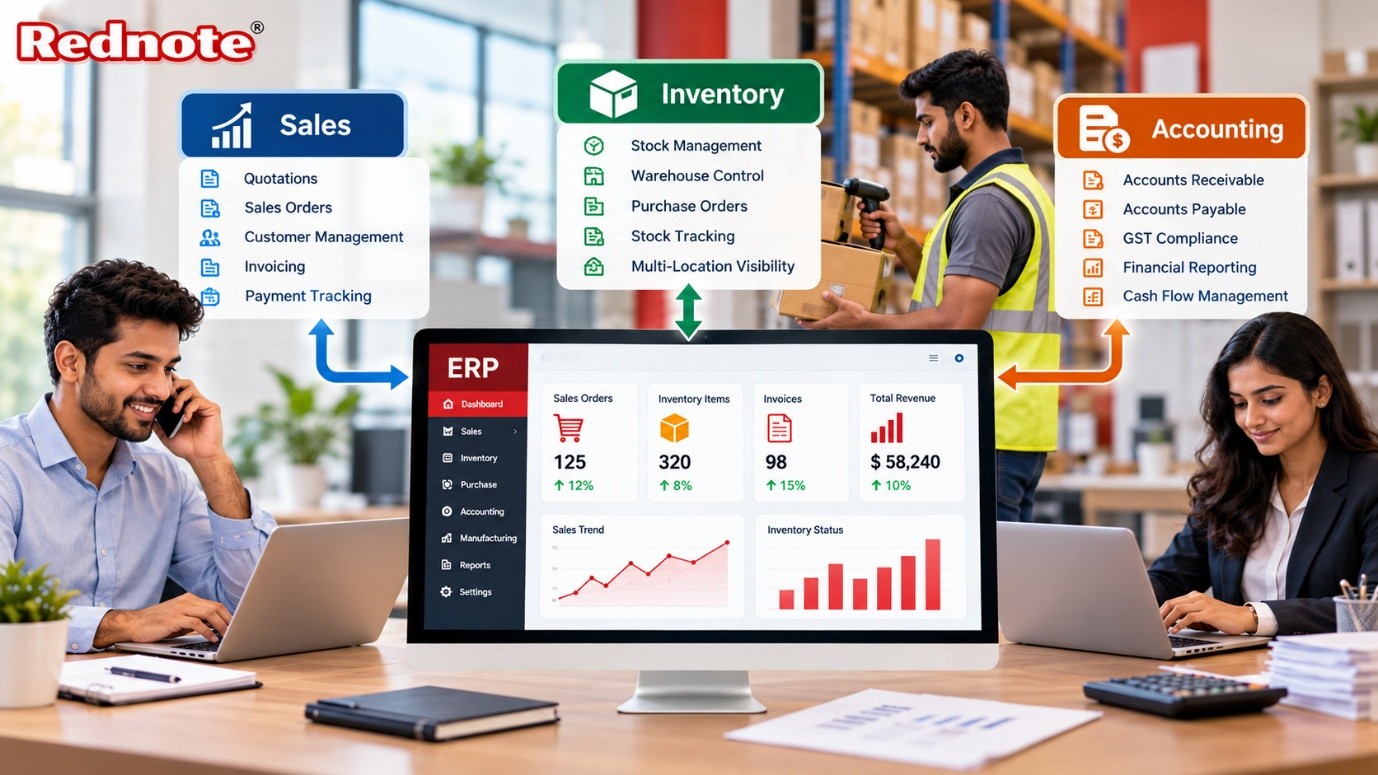
How ERP Software Integrates Sales, Inventory, and Accounting
In modern commercial operations, growth brings complexity. When sales teams close deals on one spreadsheet, warehouse managers track stock on another, and finance staff re-enter invoice details into desktop accounting tools, operational friction builds quickly. Siloed departments frequently lead to inventory discrepancies, delayed deliveries, missed follow-ups, and delayed financial reporting. Adopting an ERP software Chennai business leaders rely on—or deploying specialized cloud platforms tailored for fast-paced growth—solves these challenges by unifying sales, inventory, and accounting into a single live ecosystem.
When these three core functions operate in isolation, human error rises and execution slows. A sales representative might confirm an order for items that are out of stock, or an accountant might spend days manually reconciling dispatch slips against bank deposits. Modern Enterprise Resource Planning (ERP) software removes these bottlenecks by establishing a single source of operational truth. A single automated transaction flows seamlessly across all departments without requiring double data entry or manual verification.
The Operational Risk of Fragmented Systems
Many small and mid-sized enterprises begin operations using standalone tools: a dedicated Customer Relationship Management (CRM) app for sales reps, spreadsheet logs or standalone software for warehouse stock, and localized desktop ledger programs for accounts. While this fragmented setup works for early-stage operations, it degrades rapidly as order volume scales.
The Cost of Data Disconnects
- Delayed Decision-Making: Executive leadership cannot access an immediate, unified view of revenue, profit margins, or active liabilities.
- Inventory Misalignment: Sales representatives sell unavailable inventory, leading to customer disappointment, canceled orders, and damaged reputation.
- Revenue Leakage: Unbilled dispatches, uncollected receivables, and unrecorded return vouchers slip past accounting oversight.
- Wasted Administrative Hours: Finance personnel spend significant time re-keying invoice figures, cross-checking tax details, and balancing accounts payable and receivable.
Transitioning to unified cloud platforms like rednote.in resolves these disconnected processes by connecting frontline customer interactions directly to backend warehouse logistics and financial ledgers.
How ERP Software Bridges the Core Business Triad
To understand how integrated software improves business efficiency, it is essential to trace how data flows automatically through the three core operational modules: Sales, Inventory, and Accounting.
[ Sales Order Created ] ➔ [ Automated Stock Reservation ] ➔ [ Real-time Ledger Update ]
Updates CRM & Price Updates Warehouse Qty & Generates Invoice & Updates
Schedules Dispatch Triggers Reorder Warning GST / Tax Accounts
1. Sales Module Automation
The journey begins at customer touchpoints. Whether an order enters via sales representatives, an e-commerce storefront, or a retail Point of Sale (POS) terminal, the sales module records every detail automatically:
- Instant Quotations and Proforma Invoices: Quotations convert to sales orders or proforma invoices in a few clicks.
- Customer History Tracking: Payment terms, credit limits, and past order records are checked automatically before order confirmation.
- Automated Dispatch Scheduling: Upon order confirmation, the ERP generates delivery challans and e-way bills without manual data re-entry.
2. Live Inventory and Warehouse Synchronization
The moment a sales order is created, the integrated inventory system updates automatically without human intervention:
- Real-Time Stock Deduction: Stock quantities drop immediately across connected multi-warehouse locations, keeping available balance figures accurate.
- Automated Reorder Points: When raw materials or finished goods dip below set thresholds, the software prompts or auto-generates purchase requests.
- Batch and Serial Tracking: Full traceability ensures that items subject to expiration dates, batch runs, or quality checks are tracked accurately from entry to dispatch.
Businesses scaling rapidly in tech and commercial centers count on robust solutions like ERP software Bangalore companies deploy to maintain precise control over inventory allocation and multi-branch warehouse distribution.
3. Integrated Accounting and Automated Financial Ledgers
The financial impact of every sales transaction or inventory movement is calculated instantly in the ledger module:
- Immediate Revenue Recognition: Generating a sales invoice updates accounts receivable, ledger entries, and cash flow forecasts instantly.
- Automated Cost of Goods Sold (COGS): As inventory leaves the warehouse, item cost calculations automatically feed financial reports to keep gross margin data accurate.
- Built-in Tax Compliance: Tax fields, including GST calculations, flow through system invoicing to simplify monthly, quarterly, and annual return filings.
Step-by-Step: The Journey of a Single Integrated Transaction
To visualize the workflow, consider what happens when a customer places an order inside an integrated ERP framework:
- Order Capture: A sales rep creates a sales order in the system. The platform checks the client's available credit limit and pre-set payment terms instantly.
- Stock Reservation: The ERP checks stock across warehouse locations, reserves the required units, and updates the active availability list.
- Dispatch & Documentation: The warehouse packs the order, while the system generates the delivery challan and e-way bill using pre-loaded order data.
- Automated Billing: Converting the dispatch record into a final sales invoice updates the client ledger and applies appropriate tax rules automatically.
- Real-Time Financial Updates: The accounting module posts the invoice, updates the cash flow forecast, updates profit-and-loss statements, and logs the receivable status for follow-up reminders.
This automated pipeline eliminates duplicate data entry, reduces processing delays, and prevents billing errors. Manufacturing hubs running complex production schedules depend on tailored systems like ERP software Coimbatore enterprises implement to align raw material procurement directly with live customer demand.
Key Benefits of Unifying Sales, Stock, and Accounting
| Operational Domain | Disconnected Systems | Integrated ERP System |
|---|---|---|
| Data Accuracy | High error risk due to repetitive manual re-entry. | Single-entry system; live data updates across all modules. |
| Order Processing Time | Hours or days spent verifying stock and creating invoices manually. | Minutes; automated generation of quotations, invoices, and dispatch slips. |
| Inventory Visibility | Periodic manual counts; frequent stockouts or overstocking. | Real-time tracking across multiple locations with low-stock alerts. |
| Financial Reporting | End-of-month delays while reconciling spreadsheets. | On-demand financial statements, balance sheets, and tax reports. |
| Customer Experience | Stockout delays, incorrect billing, and slow responses. | Prompt order fulfillment, transparent tracking, and reliable service. |
Industry-Specific Applications of Integrated ERP
Different business models rely on integrated sales, inventory, and accounting workflows to meet distinct operational goals:
Discrete and Process Manufacturing
Manufacturers must align sales demand with raw material supplies and shop-floor capacity. Multi-level Bill of Materials (BOM) management, Material Requirement Planning (MRP), and subcontracting tracking allow production floors to run efficiently without raw material shortages. Industrial hubs rely on targeted solutions like ERP software Hyderabad providers offer to synchronize batch production, quality checks, and cost accounting.
Trading, Distribution, and Retail
Wholesalers and retail networks process large transaction volumes daily. Real-time point-of-sale integration, multi-UOM (Unit of Measure) support, and automated price lists help trading firms handle high order volumes accurately. High-volume commercial centers benefit from platforms like ERP software Mumbai trading businesses use to maintain accurate multi-branch inventory control and rapid dispatch workflows.
Essential Features to Look for in an ERP Solution
When evaluating an ERP platform for your organization, prioritize systems that offer:
- Modular Scalability: Start with key core modules (Sales, Accounting, Inventory) and add HRMS, Payroll, or Quality Control as your business expands.
- Cloud Accessibility: Web-based, real-time access allows field sales reps, warehouse managers, and finance teams to work on shared data securely from any location.
- Ease of Implementation: User-friendly interfaces, pre-configured report templates, and fast onboarding schedules ensure high staff adoption rates without operational disruption.
- Localized Support: Responsive technical support in regional languages simplifies deployment, user training, and daily troubleshooting.
Deploying a modern cloud architecture like rednote.in provides growing organizations with an adaptable foundation for operational tracking and scalable business expansion.
Streamline Your Core Business Workflows
Integrating sales, inventory, and accounting is a strategic necessity for businesses looking to eliminate operational friction and scale efficiently. Removing manual data entry bridges functional divides between departments, gives leadership actionable live insights, and delivers reliable customer experiences.
Upgrading from fragmented spreadsheets or legacy desktop applications to a unified, cloud-based platform delivers the operational speed and visibility required in today's fast-paced market. Partnering with a tailored platform—whether you require an ERP software Hyderabad enterprise setup, an ERP software Chennai installation, or localized deployments across ERP software Bangalore, ERP software Coimbatore, or ERP software Mumbai regions—ensures your organization operates with maximum efficiency, precision, and financial control.