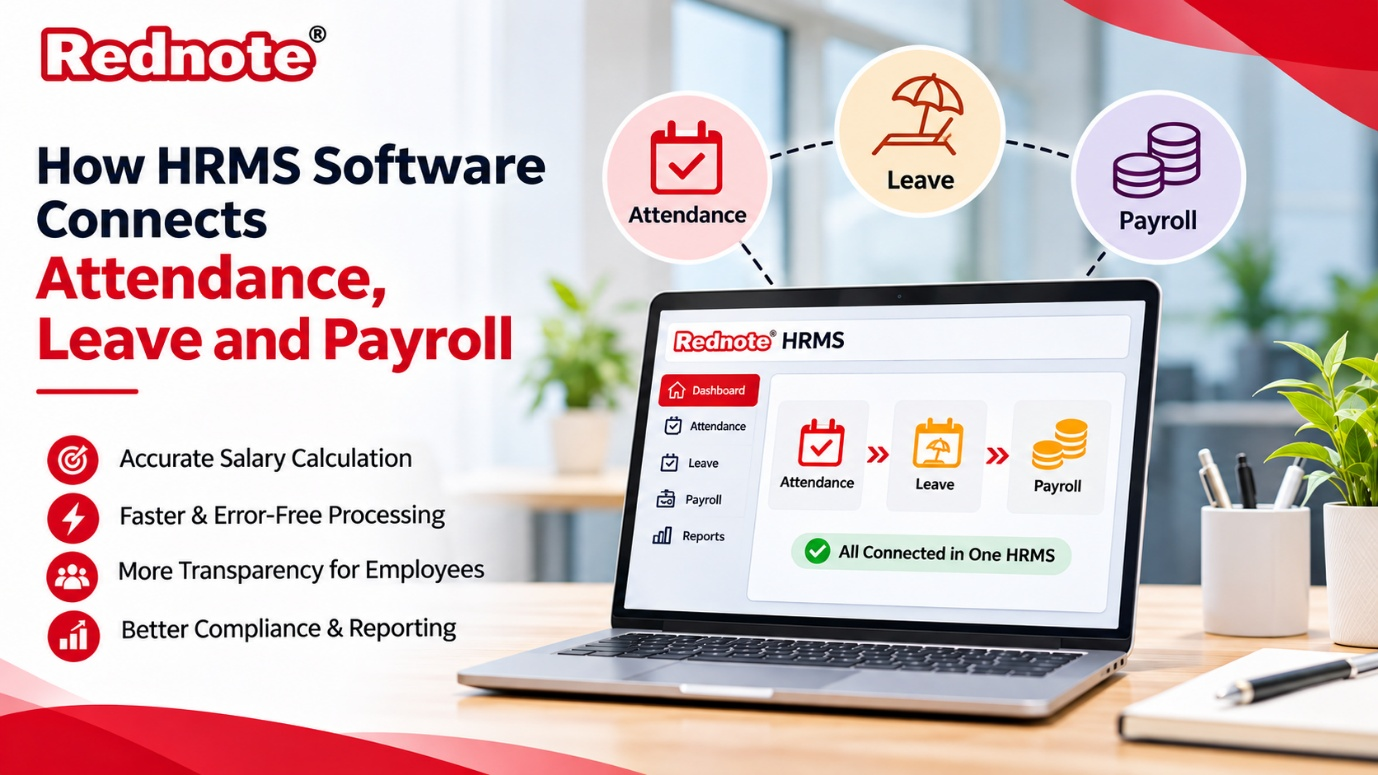
How HRMS Software Connects Attendance, Leave and Payroll
Every HR manager knows the last week of the month. Attendance sheets arrive late, leave requests sit in someone’s email, and the payroll team is chasing three people to confirm who was absent on the 14th. Salary day gets closer, and mistakes slip in. A good HRMS software removes this stress by connecting attendance, leave and payroll in one place, so each part feeds the next without anyone copying numbers by hand.
This blog explains how that connection works, why it matters, and what you should look for if you are planning to make the switch.
Why Attendance, Leave and Payroll Cannot Live Separately
On paper, attendance, leave and payroll look like three different jobs. In reality, they are one chain.
Attendance tells you who worked and for how long. Leave tells you who was away with permission. Payroll turns both into a salary figure. If any link in this chain is weak, the final pay is wrong. An employee who was on approved leave gets a pay cut, or someone who came in late for five days gets full pay. Either way, you end up with unhappy people and extra work for HR.
Many small and mid-sized companies still run this chain on spreadsheets. One file for attendance, another for leave balances, a third for salary. Each file has its own owner, its own format and its own errors. When data has to move between them, someone types it in again, and that is where most mistakes begin.
How Attendance Data Flows Into the System
The first step is capturing attendance properly. Modern platforms support several methods, so you can pick what suits your workplace:
- Biometric or face recognition devices at the office
- A mobile app with GPS check-in for field staff
- Web check-in for remote and hybrid teams
- Shift-based punching for factories, shops and hospitals
Every punch goes straight into the central record. There is no need to export a file and send it around. The software also applies your rules automatically, such as grace time, half-day cut-offs, overtime limits and weekly offs. If someone punches in 20 minutes late, the system already knows whether that counts as a late mark, a half day or nothing at all.
Managers can see their team’s attendance live, and employees can raise a correction request if they forgot to punch. Once approved, the correction updates the record at once. This matters because clean attendance is the base of everything that follows.
Where Leave Management Fits In
Now think about leave. When an employee applies for leave in the system, the request goes to the reporting manager. The manager approves or rejects it from their phone or laptop. The moment it is approved, three things happen together:
- The leave balance is reduced.
- The attendance calendar shows the day as approved leave, not absence.
- The payroll record is told whether that day is paid or unpaid.
Nobody has to tell the payroll team separately. This is the real value of connected HR software: one action updates every related record.
The system also handles the rules that cause so much confusion in manual work. Casual leave, sick leave, earned leave, maternity leave, comp-offs and holidays can all be set up with their own accrual, carry-forward and encashment rules. If a company has different policies for different locations or employee grades, those can be set up too.
Another benefit is clarity for employees. They can check their own balance at any time, so there are fewer questions to HR and fewer arguments at the end of the month.
How Payroll Pulls Everything Together
This is where the connection pays off. When payroll day comes, the system already holds the attendance and leave data for each employee. It knows total working days, paid leave, unpaid leave, overtime hours and late marks.
A reliable payroll software module uses these figures to calculate salary automatically. It works out:
- Basic pay, HRA, allowances and other earnings
- Deductions for unpaid leave or loss of pay
- Overtime payments
- PF, ESI, professional tax and TDS
- Loan or advance recoveries
- Bonuses, incentives and reimbursements
Because the inputs are already verified, HR only needs to review exceptions rather than check every single record. What used to take three or four days can often be finished in a few hours.
Payslips are generated and shared with employees on the portal or app. Bank transfer files can be created in the format your bank needs. Statutory reports and returns are prepared from the same data, which makes compliance far less stressful.
What Happens When These Three Are Not Connected
It helps to look at the problems this setup avoids.
Wrong salary calculations. Manual transfers lead to typing errors, missed leave entries and wrong loss-of-pay counts. Even a small error affects trust.
Time wasted on repeat work. HR teams often spend more time cross-checking than doing meaningful work like hiring, training and engagement.
Compliance risk. If attendance and payroll records do not match, an audit becomes painful. Wrong PF or ESI contributions can bring penalties.
No clear view of the business. Without joined-up data, you cannot easily see absenteeism trends, overtime costs or leave patterns across departments.
Frustrated employees. Few things upset a team faster than a salary mistake. Repeated errors push people to look elsewhere.
Benefits You Can Expect
Once these modules work together, the improvements are easy to notice.
Accuracy. Data is entered once and used everywhere, so errors drop sharply.
Speed. Payroll runs faster because there is no collecting, chasing and re-checking.
Transparency. Employees see their own attendance, leave and payslips. Managers see their team’s status. Everyone works from the same facts.
Better compliance. Statutory calculations follow current rules, and records are stored safely for audits.
Useful reports. You can look at attendance patterns, overtime cost, leave liability and salary trends without building spreadsheets.
More time for people work. When routine tasks are automated, HR can focus on culture, hiring and retention.
What to Look for When Choosing a Solution
Not every platform connects these areas equally well. Before you decide, check the following:
- True integration. Attendance, leave and payroll should share one database, not just exchange files.
- Flexible policy settings. You should be able to set your own shift, leave and salary rules without custom coding.
- Statutory support. It should handle PF, ESI, PT, TDS and labour compliance as per Indian rules.
- Mobile access. Employees and managers should be able to do most tasks from a phone.
- Easy reports. Look for ready-made reports and the option to download them.
- Data security. Role-based access, backups and encryption are essential, since salary data is sensitive.
- Support and training. A clear setup process and responsive support save a lot of trouble in the first few months.
If you want a complete HR payroll software that covers all these points, you can explore the solutions available at rednote.in and see how they match your needs.
Tips for a Smooth Implementation
Switching systems takes some planning, but it does not have to be painful.
- Clean your data first. Update employee records, salary structures and leave balances before the move.
- Write down your policies. Shift timings, leave rules and overtime norms should be clear before setup.
- Start with a pilot. Run the new system alongside the old one for a month to compare results.
- Train managers and employees. A short session on how to punch, apply for leave and read a payslip saves many questions later.
- Review after the first cycle. Check where adjustments are needed and fix them early.
Final Thoughts
Attendance, leave and payroll are really one connected process, and treating them as separate tasks is what creates delays and mistakes. When they sit together in one system, the data moves on its own, salaries are calculated on correct inputs, and HR gets its time back. Employees also get a more transparent and fair experience.
If your team is still stuck with spreadsheets and month-end confusion, now is a good time to look at a modern HRMS software. Visit rednote.in to understand how a connected system can make your attendance, leave and salary processing simpler and more reliable.