



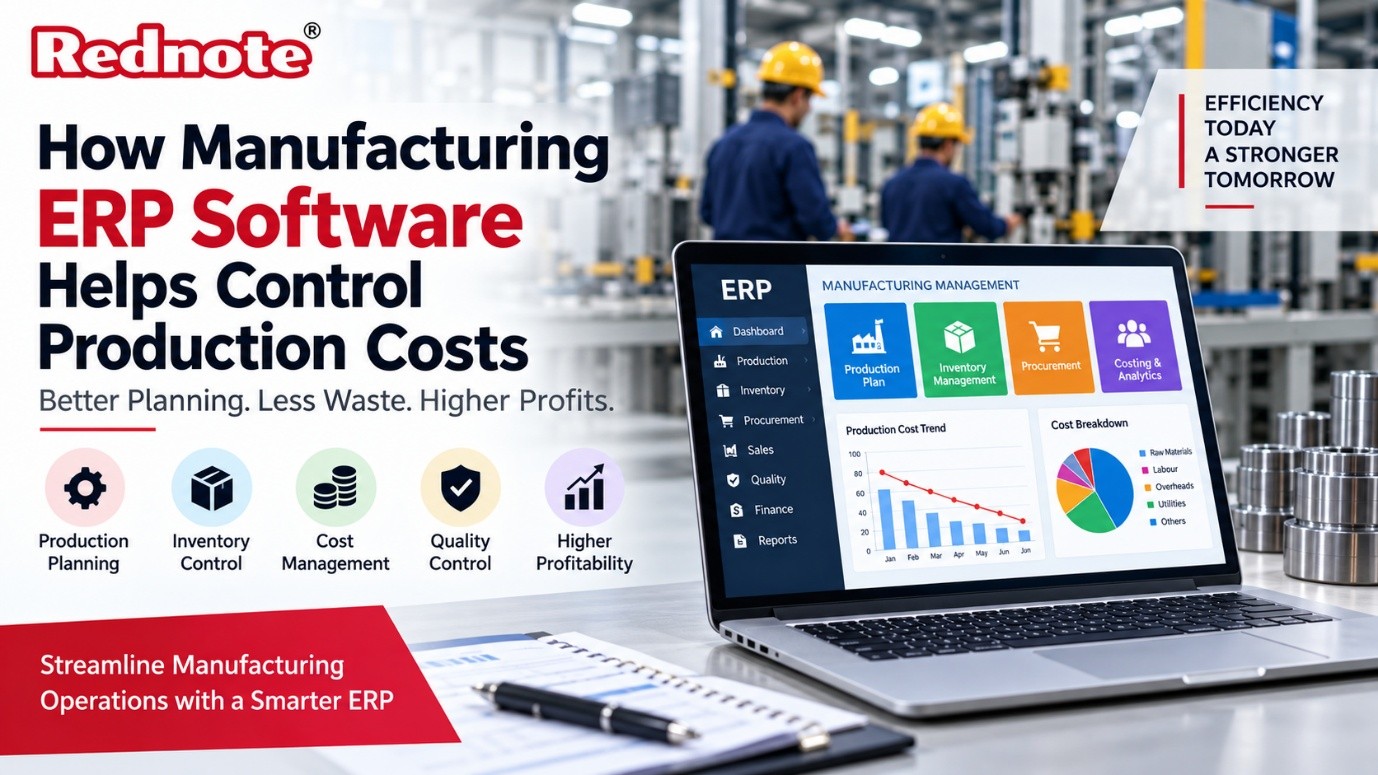
How Manufacturing ERP Software Helps Control Production Costs
Running a shop floor efficiently in today’s volatile market is no small feat. Raw material prices swing unexpectedly, labour costs keep rising, and operational leaks quietly eat away at margins. For modern industrial leaders, controlling shop floor expenses is no longer just about squeezing vendors or cutting corners—it requires sharp visibility across every single stage of production. This is precisely where implementing modern Manufacturing ERP software becomes a game-changer for growing enterprises.
By unifying procurement, shop floor tracking, inventory levels, and financial records into a single digital engine, plant managers can pinpoint hidden bottlenecks and prevent expensive material wastage before it damages their bottom line. A robust platform like Rednote gives manufacturers the real-time control they need to keep every order profitable while scaling operations smoothly.
The True Cost of Uncontrolled Production Expenses
To understand how software lowers expenses, it helps to identify where money usually slips away in traditional shop floors:
- Excess Raw Material Scrap: Without precise recipes or Bill of Materials (BOM) management, workers often over-allocate raw materials or generate unnecessary scrap during cutting, mixing, or fabrication.
- Unplanned Equipment Downtime: Reactive maintenance means machines break down mid-shift, halting entire assembly lines while idle labour costs accrue.
- Excessive Work-In-Progress (WIP) Inventory: Capital gets locked up in half-finished assemblies sitting on the shop floor, occupying valuable floor space and risking damage or obsolescence.
- Manual Data Entry Errors: Paper job cards and fragmented spreadsheets lead to inaccurate inventory counts, stockouts, duplicate purchase orders, and delayed shipments.
Key Ways Manufacturing ERP Software Drives Down Costs
Adopting a specialized ERP software for manufacturing company operations addresses these challenges at their root cause. Here is how digital transformation directly translates into cost savings.
1. Accurate Material Requirement Planning (MRP)
Procurement teams often struggle with two extremes: stocking too much inventory (locking up cash) or running out of critical parts (stopping production lines).
An integrated ERP software continuously calculates exact inventory needs based on incoming sales orders, current warehouse stock, and defined Bill of Materials (BOM). By automating Material Requirement Planning (MRP), procurement managers purchase only what is needed, exactly when it is needed. This eliminates emergency freight charges and reduces warehouse carrying expenses by up to 20–30%.
2. Precise Batch and Job-Level Costing
Do you know the exact cost per unit of every batch leaving your factory? Most traditional plants rely on end-of-month estimates that blur labor, machine overhead, and material variance together.
With dynamic production costing features, manufacturers can track direct expenses alongside indirect overheads on a per-batch or per-job basis. If a specific production line consumes 15% more power or raw material than estimated, plant floor supervisors receive immediate alerts to investigate and correct the process before running subsequent batches.
3. Reduction of Scrap and Material Waste
Material wastage is one of the quietest margin killers in production. Modern Manufacturing ERP software tracks lot numbers, serial numbers, and raw material utilization throughout the production cycle.
By enforcing parameter-based quality inspections during Goods Receipt Notes (GRN) and multi-stage line checks, substandard inputs are flagged before they enter the main assembly line. This drastically reduces overall rework cycles and scrap generation.
4. Efficient Subcontracting and Job Work Management
Outsourcing specialized processes like heat treatment, powder coating, or precision machining is common practice, but tracking job-work vendor yields can be chaotic.
A specialized platform allows you to issue raw materials to third-party subcontractors, monitor processing turnaround times, and verify yield quantities upon return. This visibility ensures vendors account for every unit of raw material issued, protecting your business against unverified material loss.
5. Streamlined Warehouse & Multi-Shelf Tracking
Searching for lost parts in a sprawling warehouse wastes time and delays assembly lines. Advanced warehouse features assign specific shelf numbers and tracking attributes to incoming items. When stock movements are automated, operators know exact item locations instantly, cutting down internal material handling labor and preventing duplicate orders of items that were simply misplaced.
6. Seamless Financial Synchronization
Disconnects between production teams and accounting departments lead to delayed invoicing, uncollected revenues, and cash flow strain. Advanced solutions bridge this gap by syncing delivery challans, purchase receipts, and sales invoices directly with core accounting workflows or platforms like Tally. Synchronizing these processes speeds up billing cycles, minimizes administrative overhead, and prevents invoice errors.
Realizing ROI with the Right ERP Strategy
Implementing a digital operational system is an investment, but when aligned with lean principles, the returns compound quickly:
| Operational Area | Traditional / Manual Process | ERP-Driven Process | Direct Cost Benefit |
|---|---|---|---|
| Material Purchasing | Guesswork based on historical trends | Automated MRP aligned with active orders | Prevents overstocking and cash tie-ups |
| Shop Floor Tracking | Paper job cards updated at end of shift | Real-time digital status tracking | Minimizes idle machine time |
Why Indian Manufacturers Are Rapidly Automating
As industrial corridors expand across manufacturing hubs like Chennai, Coimbatore, Mumbai, and Bengaluru, companies face growing local and international competition. Relying on outdated manual registers or basic accounting utilities leaves little room to protect profit margins against sudden price shifts.
Deploying a modern ERP software India solution tailored for local industrial norms helps organizations streamline eInvoicing compliance, maintain multi-location warehouse oversight, and maintain lean overheads. Software designed specifically for Indian production environments takes local tax structures, subcontracting norms, and Tally integration requirements into account right out of the box.
When choosing a digital backbone for your operations, selecting a scalable platform like Rednote ensures your plant floor gains end-to-end visibility—from initial quotation to final invoice dispatch—without burdening your team with complex or rigid workflows.
Step-by-Step Implementation Approach to Maximize Savings
To ensure your cost-control initiatives pay off during rollout, adopt a structured step-by-step approach:
- Clean Your Master Data: Standardize your Bill of Materials (BOM), part numbers, and vendor master data before importing them into your new system. Accurate data guarantees accurate MRP calculations.
- Phase the Rollout: Begin with core inventory, procurement, and BOM modules before expanding into advanced subcontracting, automated approvals, and complex batch routing.
- Train Shop Floor Teams First: System adoption lives or dies on the factory floor. Ensure machine operators and storekeepers understand how quick status updates directly protect product quality and job security.
- Monitor Overhead Variances: Use production costing reports regularly during weekly management reviews to catch rising material costs or labor inefficiencies early.
Conclusion
Controlling production costs is not about cutting corners or sacrificing product quality—it is about removing friction, material waste, and opacity from your day-to-day operations. Implementing a reliable ERP software India infrastructure arms your management team with live shop floor data, precise material planning, automated quality checks, and real-time expense tracking.
When you eliminate inventory deadweight and automate manual workflows, every unit coming off your assembly line becomes leaner and more profitable. Investing in digital transformation today builds the operational discipline required to protect your business margins for years to come.