



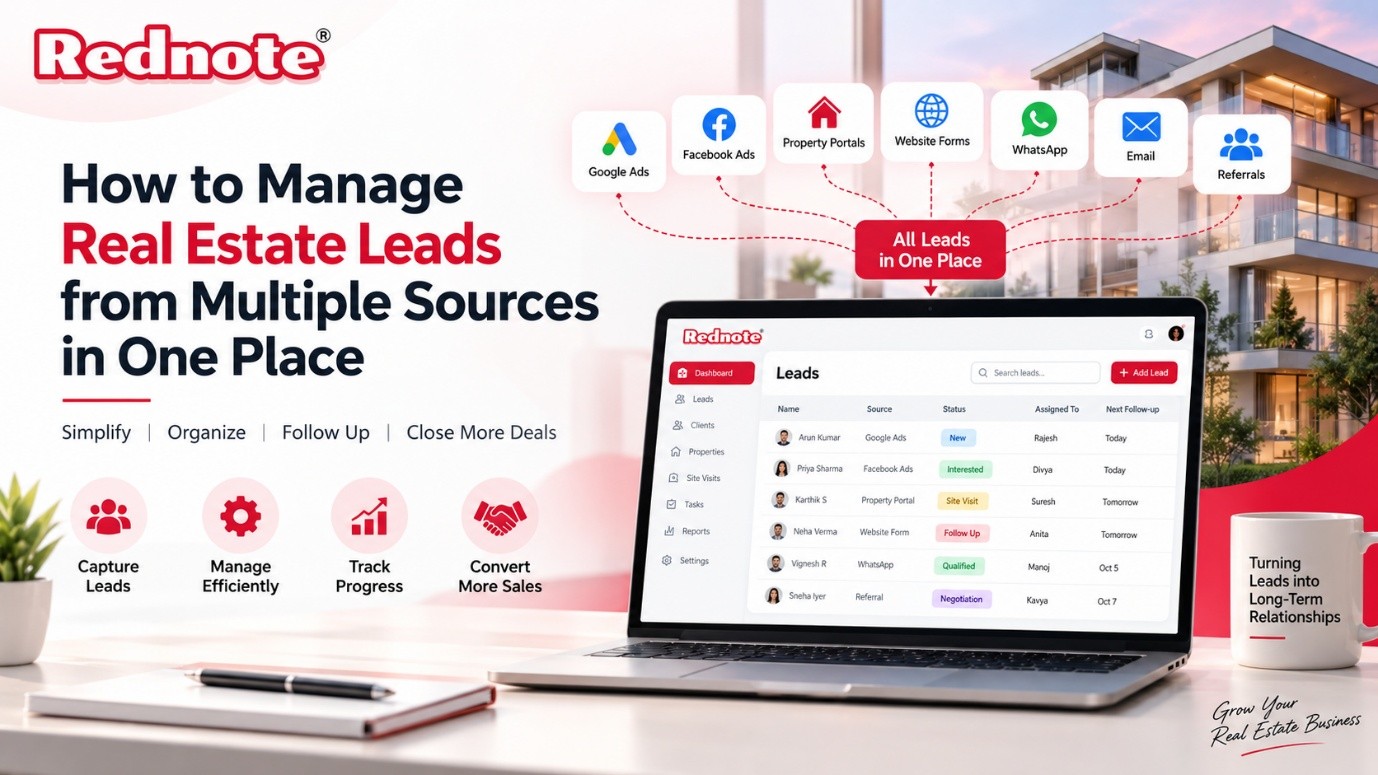
How to Manage Real Estate Leads from Multiple Sources in One Place
If you have ever spent a busy Monday morning toggling between 99acres, Magicbricks, Housing.com, Facebook ad dashboards, and messy WhatsApp chats, you already know the chaos of modern property marketing. Today, buyers reach out from every conceivable digital door. While generating interest across several channels keeps your sales pipeline warm, manual tracking quickly turns into a nightmare. Inquiries drop through the cracks, response times slow down, and agents end up chasing duplicate contacts. The secret to scaling your property business lies in unifying every single inquiry into a single dashboard. By leveraging specialized Real estate CRM software, developers and agents can streamline their entire sales process, ensure zero lead leakage, and focus on what truly matters: closing deals and building lasting client relationships.
The True Cost of Managing Scattered Property Inquiries
When inquiries are scattered across different platforms, your sales workflow suffers in subtle yet costly ways. A delay of even fifteen minutes in acknowledging an inquiry can mean losing a high-intent buyer to a competitor who responded instantly.
| Parameter | Scattered Leads (Traditional Way) | Centralized CRM (Modern Solution) |
|---|---|---|
| Lead Sources | 99acres, Magicbricks, Facebook Ads, Google Ads, Channel Partners | 99acres, Magicbricks, Facebook Ads, Google Ads, Channel Partners |
| Central Hub | None (Inquiries isolated across platforms) | RedNote Centralized Dashboard |
| Workflow Process | Manual entry, missed calls, and slow responses | Instant lead assignment and automated follow-ups |
| Final Outcome | High Rate of Lead Leakage | High Conversion Rate |
Here are the primary operational friction points businesses face without a central hub:
1. Lead Leakage and Delayed Response Times
When prospective buyers submit a form on Facebook Ads or search portals, they expect immediate answers. Exporting CSV files at the end of the day or relying on staff to manually check email notifications creates massive bottlenecks.
2. Duplicate Data and Agent Conflicts
When a buyer inquires about a project through both a portal ad and a channel partner, separate agents might reach out simultaneously. Without an automated duplicate checker, this leads to awkward customer interactions and internal team friction.
3. Disjointed Communication Histories
If one sales representative takes a call, another sends a WhatsApp message, and a third sends an email quote, tracking the buyer's journey becomes impossible. Without a shared timeline, your team loses context during site visits and negotiation phases.
4. Poor Visibility for Decision-Makers
When lead channels are disconnected, calculating your true Cost Per Lead (CPL) and ROI per channel is nearly impossible. You might continue spending heavily on ad platforms that generate high volumes of low-quality inquiries while underinvesting in channels that actually convert into booked units.
Steps to Centralize Your Property Lead Management
To transform your lead pipeline from a chaotic web of logins into a streamlined sales engine, follow this practical, step-by-step strategy:
Step 1: Audit All Inquiry Touchpoints
Document every channel where prospective buyers interact with your business:
- Property Listing Portals: 99acres, Magicbricks, Housing.com, NoBroker
- Organic Channels: Company website forms, landing pages, incoming calls
- Offline & Network Channels: Channel Partner (CP) networks, site visit registration desks, newspaper ads
Step 2: Implement Real-Time Integration
Once mapped, link these channels directly into your central software using native webhooks, direct platform APIs, or email parsers. The goal is simple: the moment an inquiry form is submitted anywhere online, the buyer's record must instantly appear on your master database without manual intervention.
Step 3: Establish Automated Allocation and Instant Verification
Set up round-robin or criteria-based distribution rules inside your database. Inquiries for 2-BHK apartments can go directly to designated residential specialists, while commercial inquiries route to high-value project managers. Simultaneously, trigger an automated WhatsApp or SMS confirmation to the buyer so they know their inquiry has been received.
Step 4: Systematize Site Visits and Follow-Up Workflows
Getting the lead into your system is only 20% of the battle; closing requires disciplined nurturing. Establish mandatory follow-up schedules with built-in alerts for site visits, revisits, document verification, and booking confirmation.
Essential Features to Look For in a Centralized System
Not all software platforms handle property sales well. Generic CRMs often lack the specialized fields needed for multi-stage site visits, channel partner management, and unit inventory tracking.
When evaluating a solution, ensure it includes these critical features:
- Omnichannel Auto-Capture: Direct, out-of-the-box connectors for major ad platforms and property search portals.
- Property & Inventory Management: A real-time matrix showing available, blocked, and sold units, accessible to field agents on mobile devices.
- Dedicated Channel Partner (CP) Portals: A transparent portal where brokers can upload client contacts, verify lead validity automatically, and monitor deal status in real time without conflicting with direct sales teams.
- Built-in Cloud Telephony and Call Recording: Automatic call logging, playback options for quality training, and missed-call tracking to ensure complete team accountability.
- Automated WhatsApp, Email, and SMS Engines: Instant auto-responses, drip sequences, and broadcast capabilities directly integrated into customer record pages.
Modern solutions like rednote are built specifically to solve these industry challenges. Tailored to local sales workflows, rednote offers native integrations with platforms like 99acres and Magicbricks alongside built-in site visit tracking, automated duplicate detection, and real-time inventory management.
Specialized CRM Use Cases across the Market
The property market involves various business models, and a centralized strategy works best when aligned with your specific operational needs.
1. The Local Real Estate Agent
For individual brokers and small agencies in competitive regional hubs, adopting tailored Real estate CRM India solutions helps level the playing field against larger firms. Independent brokers can capture listing inquiries on their phones, trigger instant WhatsApp follow-ups, and share fresh property images directly from a mobile dashboard while on the go.
2. High-Performing Brokerage Teams
When choosing the Best CRM for real estate agents, scalability, mobile responsiveness, and call-logging capabilities are top priorities. Agents need to schedule revisit alerts, log customer preferences, and review call recordings right after completing a site visit.
3. Large-Scale Builders and Promoters
Enterprise builders managing multi-tower residential projects require a robust CRM for real estate developers. Developer-focused platforms go beyond basic lead tracking—they manage complex channel partner hierarchies, automate OTP-verified site visits, handle unit blocking workflows, and sync inventory status live across internal sales desks and external brokerage partners.
5 Practical Strategies to Maximize Lead Conversion
Consolidating your lead data into one system is a massive operational shift. To turn that organized data into closed bookings, implement these five practical strategies:
1. Enforce the "5-Minute Contact Rule"
Set system alerts that notify agents the moment a new high-intent inquiry arrives. Research consistently shows that contacting a prospective buyer within five minutes increases qualifying chances by over 300% compared to waiting an hour.
2. Leverage "Re-engaged Logic" for Cold Contacts
Not every lead buys immediately. Many buyers pause their search for months before resuming. Configure your software to track re-engagement—such as a buyer opening a WhatsApp brochure three months later—and automatically alert the assigned agent to reach out while interest is fresh.
3. Maintain Complete Transparency with Channel Partners
Channel partner conflicts ruin market reputation. Provide brokers with a clear portal where they can submit contacts and instantly verify whether a buyer is already registered in your database. This eliminates duplicate commission claims and builds long-term trust with partner networks.
4. Implement OTP-Verified Site Visits
To stop fake entries and ensure accurate field reporting, require site supervisors to confirm buyer check-ins via OTP verification on their mobile apps. This ensures your sales data reflects actual footfalls and genuine customer interest.
5. Continuously Analyze Channel ROI
Use centralized reporting to evaluate conversion performance per source. If Facebook Ads produce 500 leads with a 1% site-visit conversion rate, while a vertical listing portal generates 50 leads with a 20% conversion rate, reallocate your ad budgets accordingly.
Conclusion
Managing property inquiries across multiple isolated platforms costs your business valuable time, money, and deals. By centralizing your incoming inquiries into one organized dashboard, you equip your sales team to respond instantly, nurture relationships systematically, and close bookings faster. Deploying a purpose-built Real estate CRM software brings complete clarity to your pipeline, eliminates lead leakage, and gives you full control over your sales operations from initial inquiry to final handover.