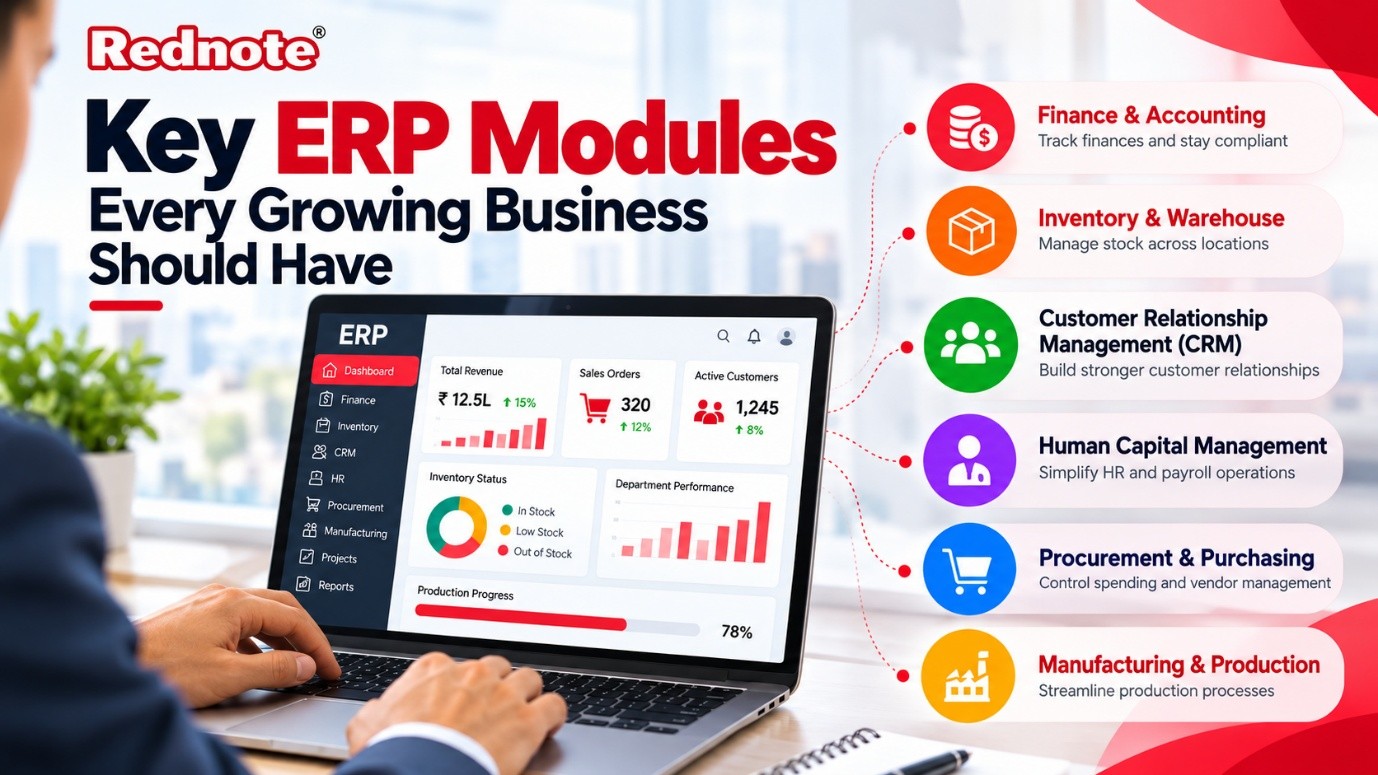
Key ERP Modules Every Growing Business Should Have
Managing a rapidly expanding enterprise comes with complex operational challenges. As your customer base grows, your inventory expands, and your workforce scales, relying on disconnected spreadsheets or standalone software can stall your progress. A modern enterprise resource planning system acts as the central command hub of your organization, bringing together core departments under one unified digital architecture. When growing enterprises upgrade their technology stack, selecting the right functional components determines how smoothly their daily workflows run. Choosing robust ERP software Chennai gives organizations the operational control needed to handle increasing workload volume, maintain cross-departmental communication, and sustain long-term business performance across regional and global markets.
Understanding which modules deliver the highest return on investment helps leadership teams make strategic software decisions. Below, we break down the fundamental ERP modules that every expanding enterprise must consider to build a scalable foundation.
Finance and Accounting Module
The financial management module serves as the foundational pillar of any enterprise platform. It replaces manual ledger posting and fragmented bookkeeping software with centralized financial tracking.
Core Capabilities:
- General Ledger & Chart of Accounts: Records all financial transactions instantly across the entire enterprise.
- Accounts Payable & Receivable (AP/AR): Automates vendor invoices, payment scheduling, and customer billing routines.
- Tax Compliance & Invoicing: Simplifies GST, local tax calculations, and localized invoice formatting.
- Financial Reporting: Generates balance sheets, profit-and-loss statements, and cash-flow projections on demand.
By consolidating cash flow data into real-time visual dashboards, finance leaders gain immediate visibility into operational expenditure, helping prevent budget overruns before they occur.
Inventory and Warehouse Management Module
For growing retail, wholesale, and manufacturing organizations, keeping accurate control of stock level changes across locations is essential. The inventory module ensures you keep optimal safety stock without tying up vital cash in excess goods.
Core Capabilities:
- Real-Time Stock Tracking: Monitors stock levels across multiple warehouses, retail locations, and transit hubs.
- Automated Reordering: Triggers automated purchase alerts when items hit predefined safety thresholds.
- Batch & Serial Number Tracking: Ensures full end-to-end product traceability for quality checks and warranty management.
- Barcode & RFID Integration: Accelerates picking, packing, and dispatch operations on the shop floor.
Deploying reliable ERP software Bangalore allows logistics and warehouse operations teams to sync live stock records with sales teams, eliminating stockouts and delivery delays.
Customer Relationship Management (CRM) Module
Acquiring customers is only half the battle; maintaining strong client relationships and closing repeat sales drives sustainable business growth. A integrated CRM module links lead generation directly to downstream order processing.
Core Capabilities:
- Lead & Opportunity Management: Tracks sales prospects through each step of your conversion pipeline.
- Automated Quotation Generation: Converts approved sales quotes directly into actionable customer sales orders.
- Customer History Tracking: Centralizes contact records, interaction history, and past order profiles.
- Post-Sales Service & Support: Manages customer tickets, inquiries, and service renewals efficiently.
When sales reps access unified customer data, they deliver personalized follow-ups, speed up deal cycles, and boost long-term customer lifetime value.
Human Capital Management (HCM) & Payroll Module
Your employees are your most critical growth asset. As headcount increases, manual attendance logging and payroll processing become prone to administrative errors and delay.
Core Capabilities:
- Employee Information Database: Stores digital personnel records, contract details, and compliance documents securely.
- Attendance & Leave Management: Integrates biometric logs, shift schedules, and online leave requests.
- Automated Payroll Processing: Calculates wages, tax deductions, allowances, and direct bank transfers accurately.
- Performance Appraisals: Manages periodic evaluation cycles, key result areas (KRAs), and employee goal setting.
Businesses utilizing advanced ERP software Coimbatore empower their teams through self-service portals, reducing routine HR desk inquiries while maintaining strict compliance with employment guidelines.
Procurement and Purchasing Module
An efficient purchasing system ensures your business gets raw materials and resale products at optimal costs without operational delays. The procurement module structures spending from initial purchase requisitions to final vendor settlements.
Core Capabilities:
- Vendor Management: Maintains pre-approved supplier lists, performance metrics, and contract terms.
- Purchase Order Automation: Converts approved stock requisitions into purchase orders automatically.
- RFQ Comparison: Facilitates side-by-side vendor quote evaluations to secure competitive pricing.
- 3-Way Matching: Verifies purchase orders, goods receipts, and vendor invoices prior to processing payment.
Streamlining purchasing workflows prevents unauthorized spending and maintains healthy vendor relationships.
Manufacturing and Production Management Module
For industrial producers and assembly-driven companies, keeping production lines synchronized with demand forecasts is essential. The production module plans shop-floor tasks, manages material allocation, and tracks actual production output.
Raw Material Procurement -> Bill of Materials (BOM) -> Work Order Execution -> Quality Control -> Finished Goods Storage
Core Capabilities:
- Bill of Materials (BOM): Defines multi-level component lists and raw material requirements for every product line.
- Work Order Generation: Schedules machinery usage, labor allocation, and shift assignments.
- Master Production Scheduling (MPS): Balances current order backlogs with long-term sales forecasts.
- Quality Assurance & Compliance: Enforces strict inspection checkpoints throughout production runs.
Implementing tailored ERP software Hyderabad gives manufacturers precise control over material consumption, minimizing waste and improving on-time order delivery rates.
Sales and Supply Chain Management Module
A connected supply chain ensures that products move smoothly from manufacturing floors to end customers without costly bottlenecks. This module unifies order processing, freight dispatch, and logistics operations.
Core Capabilities:
- Multi-Channel Sales Management: Aggregates orders originating from web stores, field reps, and retail stores.
- Dispatch & Fleet Routing: Schedules order shipments and manages delivery documentation.
- Demand Forecasting: Uses historical sales data to project future inventory needs accurately.
- Returns & Claims Management: Handles customer product returns, warranty exchanges, and credit notes smoothly.
Organizations using scalable solutions like Rednote software leverage synchronized supply chain tools to accelerate order fulfillment, build operational resilience, and protect profit margins.
Business Intelligence and Analytics Module
Data-driven decision making is critical for modern business growth. An analytics module turns raw operational data from across all departments into clear visual reports.
Core Capabilities:
- Custom Executive Dashboards: Displays real-time operational indicators and key metrics at a glance.
- Predictive Insights: Identifies emerging revenue trends, cost patterns, and seasonal demand fluctuations.
- Cross-Departmental Reporting: Pulls finance, HR, inventory, and sales data into single consolidated reports.
- Automated Data Exporting: Schedules periodic performance updates for senior executive distribution.
Using targeted ERP software Mumbai equips company leaders with real-time operational insights, replacing guesswork with data-backed business strategy.
How to Choose the Right Module Rollout Strategy
When upgrading your core software, implementing every single module simultaneously can overwhelm your team. A phased rollout allows staff to master essential modules before expanding into secondary features.
| Rollout Phase | Target Modules | Primary Objective |
|---|---|---|
| Phase 1: Core Operations | Finance, Accounting, Inventory Management | Establish centralized ledger tracking and stock visibility. |
| Phase 2: Customer & Workforce | CRM, HCM, Payroll | Streamline sales pipelines and automate administrative payroll. |
| Phase 3: Supply & Production | Procurement, Manufacturing, SCM | Optimize vendor purchasing cycles and shop-floor scheduling. |
| Phase 4: Optimization | Business Intelligence & Reporting | Gain deep real-time operational insights and forecasting clarity. |
Businesses deploying modern ERP software Pune often adopt this staged approach, minimizing business disruption while driving predictable return on investment at every milestone.
Major Business Benefits of Module Integration
Deploying a modular platform brings several crucial operational advantages:
- Elimination of Data Silos: Departments share a single source of truth, removing manual multi-entry duplication errors.
- Enhanced Operational Speed: Automated approvals and digital document routing reduce administrative delays.
- Improved Regulatory Compliance: Standardized processes enforce tax requirements and internal audit controls automatically.
- Scalable Growth Infrastructure: New modules can be unlocked seamlessly as business operations expand.
Companies utilizing robust ERP software Delhi gain an agile operating system built to withstand shifting market demands while maintaining profitability.
Conclusion
Investing in the right software layout transforms how your company manages growth. By combining essential components across finance, inventory management, customer relations, HR, procurement, and analytics into a single dashboard, your team gains complete control over daily operations. Selecting a flexible system like Rednote gives growing enterprises the modular freedom to activate features precisely when needed, keeping operations lean, agile, and structured for long-term profitability.