



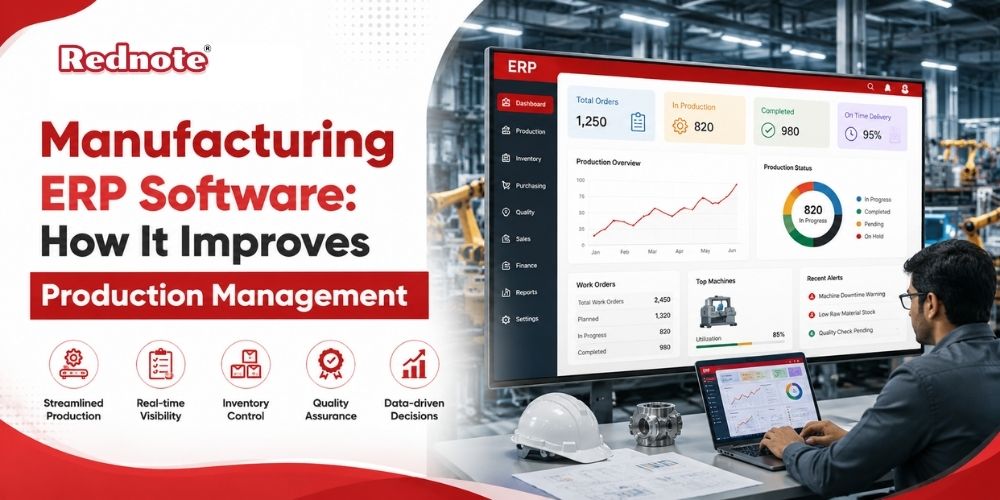
Manufacturing ERP Software: How It Improves Production Management
Manufacturing businesses need to coordinate raw materials, production schedules, employees, machines, inventory, quality checks, sales orders, and deliveries every day. When these activities are handled through spreadsheets or disconnected systems, even a small delay can affect the entire production cycle. Manufacturing ERP software helps manufacturers bring these processes together on one centralized platform, making production planning more organized, transparent, and efficient.
A modern ERP solution can connect production with procurement, inventory, sales, finance, and quality management. This allows teams to access updated information and make decisions based on actual business data instead of relying on manual calculations. For companies evaluating an ERP software for manufacturing company, choosing a system with production-specific capabilities can make a significant difference in operational efficiency.
What Is Manufacturing ERP Software?
Manufacturing ERP software is an enterprise resource planning solution designed to manage and coordinate the different activities involved in manufacturing. Instead of maintaining separate systems for purchasing, inventory, production, sales, and accounting, manufacturers can use one integrated platform to manage their operations.
A manufacturing-focused ERP can help businesses manage:
- Production planning and work orders
- Bill of Materials (BOM)
- Raw material availability
- Material Requirement Planning (MRP)
- Purchase orders and procurement
- Inventory and warehouse operations
- Sales order tracking
- Quality inspections
- Production costing
- Subcontracting
- Batch and serial number tracking
- Approvals and workflow management
- Invoicing and financial processes
Rednote, for example, provides manufacturing capabilities that connect sales orders with production planning, material availability, procurement, production orders, quality checks, warehouse management, and finished-goods processing.
Why Production Management Needs an Integrated System
Production management involves much more than converting raw materials into finished products. Manufacturers must determine what to produce, how much to produce, when to produce it, which materials are required, whether those materials are available, and whether the finished goods meet quality standards.
When these decisions are made manually, production teams may face problems such as:
- Raw material shortages
- Excess inventory
- Production delays
- Poor production scheduling
- Duplicate data entry
- Difficult order tracking
- Costing inaccuracies
- Quality control gaps
- Communication problems between departments
- Delayed customer deliveries
An integrated ERP system reduces these challenges by connecting departments and creating a common source of business information.
How ERP Improves Production Planning
One of the biggest advantages of ERP is improved production planning. Manufacturers need accurate information about customer orders, inventory levels, raw materials, production capacity, and delivery commitments before starting production.
An ERP platform allows production teams to connect sales requirements with manufacturing activities. When a sales order is created, the team can determine the materials and production requirements associated with that order.
This makes it easier to:
- Plan production quantities
- Identify required materials
- Schedule production activities
- Track work orders
- Monitor production progress
- Reduce unnecessary production
- Improve delivery planning
Rednote's manufacturing solution supports sales-order tracking and production orders, allowing production progress to be connected with customer requirements.
Better Material Requirement Planning
Raw material availability directly affects production efficiency. If an essential material is unavailable, production may stop even when employees, machines, and orders are ready.
Material Requirement Planning, or MRP, helps manufacturers determine what materials are required based on production requirements, sales orders, and Bills of Materials.
A suitable ERP software can help teams compare required materials with available inventory. When a shortage is identified, purchasing teams can initiate procurement before the shortage affects production.
Rednote's MRP functionality checks stock availability against sales orders or BOM requirements and supports purchase-order creation when materials are insufficient.
This creates a more proactive approach to procurement instead of waiting for production teams to report material shortages.
Improved Inventory and Warehouse Control
Inventory management is closely connected to production. Too little stock can stop manufacturing, while excessive stock can increase storage costs and tie up working capital.
An ERP system provides better visibility into:
- Raw material stock
- Semi-finished goods
- Finished goods
- Warehouse locations
- Shelf information
- Batch numbers
- Serial numbers
- Stock movements
- Low-stock situations
Rednote supports multiple warehouses and shelf-level stock tracking, while its plans also include batch and serial number tracking and reverse tracing capabilities.
With centralized inventory information, production and purchasing teams can work with the same data and make faster decisions.
Accurate Bill of Materials Management
A Bill of Materials defines the components and quantities required to manufacture a product. Even a small error in a BOM can affect material purchasing, production planning, inventory consumption, and product costing.
ERP software helps manufacturers maintain structured BOM information and connect it with production and MRP processes.
With an accurate BOM, manufacturers can:
- Identify required components
- Calculate material requirements
- Plan purchases
- Reduce material wastage
- Improve production consistency
- Support more accurate costing
For manufacturers producing multiple products or product variations, centralized BOM management becomes particularly important as the business grows.
Real-Time Production Tracking
Production managers need to know what is happening on the shop floor without waiting for end-of-day reports.
A modern ERP system can provide visibility into production orders, work progress, material usage, and finished-goods status. This makes it easier for managers to identify delays and take corrective action quickly.
Real-time production visibility can help answer questions such as:
- Which orders are currently in production?
- Which orders are delayed?
- Are the required materials available?
- How much has already been produced?
- Which finished goods are ready for dispatch?
- Where is a particular batch or production order?
Rednote states that its ERP supports real-time tracking of production progress, work orders, and resource allocation.
Better Quality Control
Quality problems can increase production costs and damage customer relationships. Detecting defects only after products reach the final stage can result in wasted materials, additional labour, rework, and delayed deliveries.
ERP-based quality management allows manufacturers to introduce quality checks at important stages of the production cycle.
For example, Rednote supports quality inspections during raw-material receipt and production, including parameter-based and quantity-based validation.
This helps manufacturers create a more structured quality process and identify problems earlier.
Production Costing Becomes More Transparent
Knowing the actual cost of production is essential for pricing, profitability analysis, budgeting, and business decisions.
Manufacturing costs can include:
- Raw materials
- Labor
- Manufacturing overhead
- Outsourced operations
- Other production-related expenses
Production costing within an ERP environment helps businesses organize these costs and understand the cost associated with manufacturing products.
Rednote describes production costing as a process that considers raw materials, labor, overheads, and other manufacturing expenses to determine the cost per unit produced.
Better cost visibility can help management identify inefficient processes, evaluate product profitability, and make more informed pricing decisions.
Streamlined Procurement
Production and procurement should work together. Purchasing materials too early can increase inventory holding costs, while purchasing too late can delay production.
An ERP connects procurement with actual production requirements and inventory availability.
When a material shortage is identified through MRP, purchasing teams can create purchase orders based on the requirement. This reduces the need for repeated manual stock checks.
The result is a more organized purchasing process with better visibility into what is needed and when it is needed.
Easier Subcontracting Management
Many manufacturers outsource specific operations or production activities to external vendors. Managing subcontracting manually can make it difficult to track materials, outsourced operations, vendor activities, and finished goods.
A manufacturing ERP can bring subcontracting activities into the broader production workflow.
Rednote includes subcontracting functionality designed to simplify outsourced manufacturing operations and provide related reports.
This gives production teams better visibility over both internal and external manufacturing activities.
Faster Order-to-Delivery Management
Production does not operate independently from sales. A customer order creates a requirement that can affect material planning, production, inventory, delivery, and invoicing.
When these activities are connected, businesses can follow the order from the initial sales requirement through production and final delivery.
Rednote supports sales-order tracking, production management, finished-goods stock handling, delivery challans, and invoice generation as part of its manufacturing workflow.
This connected process can reduce communication gaps between sales, production, warehouse, and finance teams.
Better Decision-Making Through Centralized Data
Manufacturing managers need accurate information to make decisions about purchasing, production capacity, inventory, costs, and customer orders.
Without centralized information, teams may spend considerable time collecting data from spreadsheets, emails, accounting systems, and separate applications.
An ERP system brings operational information together, helping management analyze business performance more effectively.
Instead of asking different departments for separate updates, decision-makers can work with information available through the centralized platform.
How to Choose the Best ERP Software for Manufacturing
Selecting the Best ERP software should not be based only on the number of features. Manufacturers should evaluate whether the system fits their actual production workflow.
Before selecting an ERP solution, consider the following factors:
1. Manufacturing Features
Check whether the platform supports production planning, BOM, MRP, work orders, inventory, quality control, and costing.
2. Scalability
The system should be capable of supporting business growth, additional users, warehouses, products, and manufacturing locations.
3. Ease of Use
A complex system can create resistance among employees. Choose an ERP that employees can understand and use efficiently.
4. Integration
Check whether the ERP can integrate with existing accounting systems and other business applications. Rednote, for example, supports synchronization with Tally for invoices, purchase invoices, products, clients, and vendors.
5. Cloud and On-Premise Options
Manufacturers should consider whether they need cloud-based access, on-premise deployment, or both. Rednote states that its ERP can be used on the cloud as well as on-premise, depending on business requirements.
6. Support and Training
Successful ERP implementation requires more than software installation. Look for a provider that offers implementation assistance, training, and ongoing support.
Why ERP Software India Is Becoming Important for Manufacturers
Manufacturing businesses in India operate in a highly competitive environment where cost control, delivery performance, inventory management, and operational efficiency are critical.
ERP software India solutions designed for local business requirements can help manufacturers bring different departments together while improving operational visibility.
Features such as e-invoicing, accounting integration, inventory management, production costing, MRP, and approval workflows can be particularly useful for growing Indian manufacturing businesses. Rednote also provides e-invoicing functionality and integration with government portals for eligible businesses.
For companies operating multiple facilities, centralized ERP management can also make it easier to coordinate warehouses, production units, and distribution activities.
Benefits of Implementing ERP for Production Management
A properly implemented ERP can deliver several operational benefits:
- Better production planning
- Improved material availability
- Reduced manual data entry
- Better inventory visibility
- Faster procurement
- Improved quality monitoring
- More accurate production costing
- Easier order tracking
- Better coordination between departments
- Improved decision-making
- Greater production transparency
- More efficient warehouse management
However, the results depend on selecting a suitable solution and implementing it according to the company's processes.
Final Thoughts
Efficient production management requires accurate planning, timely procurement, controlled inventory, consistent quality, and clear visibility from order to delivery. Manufacturing ERP software brings these activities together and gives manufacturers a structured way to manage their operations. For businesses searching for an ERP system that can support production, MRP, inventory, procurement, quality control, costing, subcontracting, and sales-order management, a manufacturing-focused platform can provide a strong foundation for operational growth. Rednote offers these capabilities along with cloud and on-premise deployment options, mobile access, multi-location management, and accounting integration. As manufacturing operations become more complex, moving away from disconnected spreadsheets and manual processes can help businesses improve control and respond faster to changing production requirements. Choosing the right ERP solution today can help create a more organized, scalable, and data-driven manufacturing operation for tomorrow.