



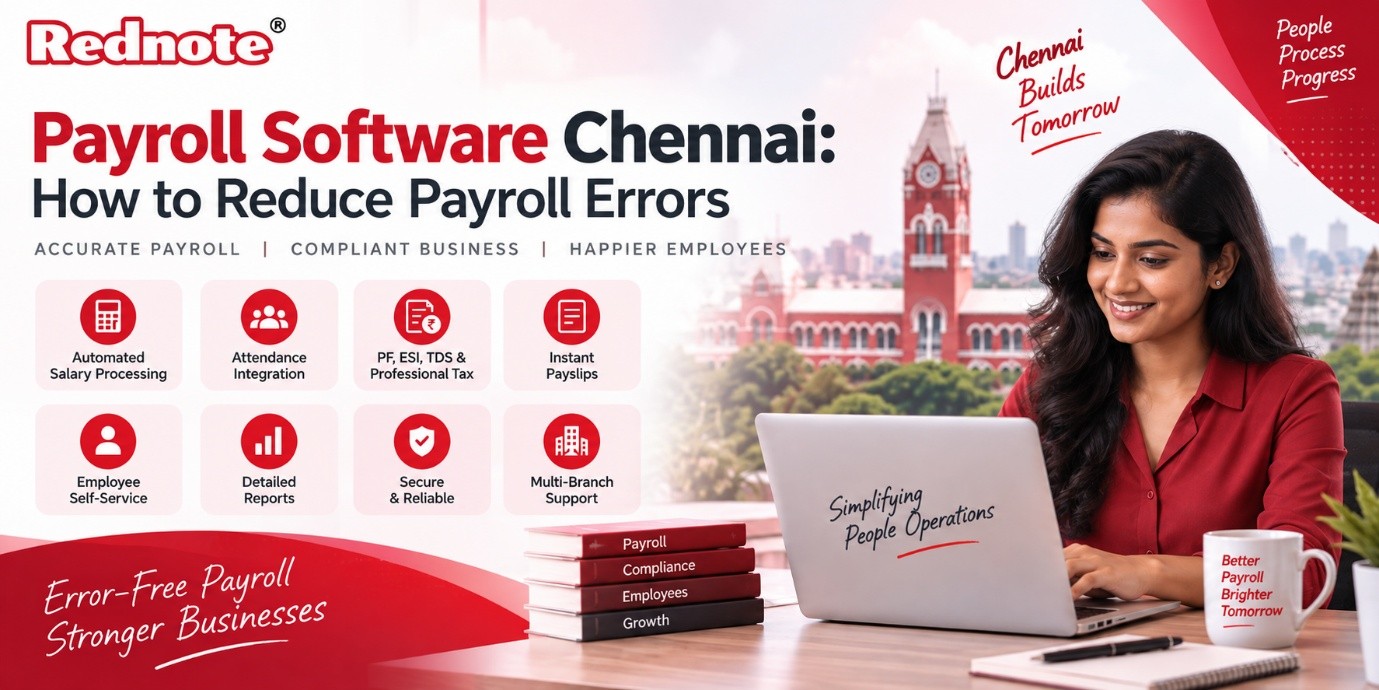
Payroll Software Chennai: How to Reduce Payroll Errors
Managing financial operations for a growing workforce in Tamil Nadu's commercial hub demands extreme accuracy, speed, and strict compliance. Whether operating an IT firm in OMR, a manufacturing plant in Ambattur, or a logistics business in Guindy, handling employee compensation manually using spreadsheets inevitably introduces costly human errors. Modern businesses are moving away from outdated manual tracking to reliable Payroll software Chennai solutions that streamline end-to-end salary processing while eliminating compliance bottlenecks. When HR teams automate complex payout calculations, statutory deductions, and attendance tracking, they safeguard the organization against financial leakages, legal penalties, and employee dissatisfaction.
Understanding how salary discrepancies occur—and deploying structured automation strategies—is essential for running an efficient workforce. This comprehensive guide breaks down why manual payroll fails, the strategic steps to minimize errors, and how modern software simplifies workforce management across local industries.
The Hidden Costs of Payroll Errors in Modern Businesses
Payroll errors rarely remain simple administrative slip-ups; they create ripple effects that harm an organization's financial health, legal standing, and internal workplace culture.
Manual Spreadsheets ──► Calculation Errors ──► Statutory Penalties
│ │
└──► Delayed Disbursements ──► Employee Discontent
1. Financial Drain and Tax Penalties
When deductions for Provident Fund (PF), Employee State Insurance (ESI), Tax Deducted at Source (TDS), or Tamil Nadu Professional Tax are miscalculated, the company faces immediate regulatory scrutiny. Miscalculating tax obligations or missing statutory filing deadlines leads to hefty interest penalties, late fees, and potential legal notices from government bodies.
2. Loss of Employee Trust
Salary is the primary contract between an employer and an employee. Delayed disbursements, incorrect overtime compensation, or unexplained net pay variations create resentment. Over time, recurring compensation discrepancies damage employee morale, increase turnover rates, and tarnish your employer brand in competitive job markets.
3. Wasted HR and Accounting Hours
HR and finance departments spend dozens of working hours every month reconciling attendance records, adjusting leave balances, correcting formulas, and re-issuing payslips. This operational inefficiency diverts valuable attention away from core business operations, talent acquisition, and strategic growth.
Common Causes of Payroll Miscalculations
To eliminate salary processing mistakes, organizations must first pinpoint where the human element breaks down in traditional workflows.
- Formula Failures in Spreadsheets: Excel formulas can be accidentally altered, broken, or overwritten when handled by multiple managers.
- Mismatched Attendance and Leave Data: Manual timecard entries, untracked casual leaves, and unverified field staff check-ins cause inaccurate loss-of-pay (LOP) deductions.
- Complex Multi-Tiered Pay Structures: Managing varying basic pay, house rent allowance (HRA), special allowances, flexible benefits, and variable bonuses across different employee tiers increases operational complexity.
- Changing Statutory Regulations: State-specific tax slabs, such as local Professional Tax revisions and updating TDS brackets, are frequently overlooked when relying on static manual workflows.
5 Practical Steps to Eliminate Payroll Errors
Transitioning from manual salary management to automated workflows requires systematic operational upgrades. Adopting a cloud-based Payroll software Chennai platform provides the structural backbone needed to guarantee monthly calculation accuracy.
Step 1: Centralize Attendance and Leave Management
Manual attendance tracking is a primary source of salary miscalculation. Integrating biometric access terminals or mobile GPS check-in tools directly into your compensation software ensures real-time synchronization. Automatically converting late arrivals, approved leaves, half-days, and overtime into exact payroll figures prevents manual data-entry errors.
Step 2: Automate Statutory Deductions and Local Compliance
Managing state and central statutory requirements requires automated compliance rules. Utilizing dedicated Payroll software Chennai applications ensures that mandatory deductions—including PF contributions, ESI payouts, TDS withholding, and Tamil Nadu Professional Tax—are computed automatically based on current regulatory guidelines. This reduces compliance risks and simplifies monthly tax filing.
Step 3: Implement Multi-Level Approval Workflows
Human verification remains essential for auditing anomalous data. Establish clear separation of duties by building structured approval hierarchies within your HR platform. For instance, allow department heads to verify attendance, HR managers to review variable bonuses, and finance leads to issue final disbursement approvals.
Step 4: Empower Staff with Employee Self-Service (ESS)
Reduce HR ticket volumes by offering employees direct access to an ESS portal. Through self-service mobile apps or web portals, staff members can view itemized payslips, submit investment proofs for TDS, upload reimbursement receipts, and monitor leave balances independently. Early transparency allows employees to highlight potential discrepancies before final salary runs are executed.
Step 5: Conduct Regular Data Audits and System Backups
Periodically audit employee master data, bank account details, PAN entries, and active employment statuses. Automation streamlines computations, but accurate foundational data remains critical. Secure cloud infrastructure ensures your financial records are backed up and protected by enterprise-grade encryption.
Comparing Manual Payroll vs. Automated Cloud Payroll
| Feature / Operational Parameter | Manual Processing (Excel / Paper) | Cloud-Based Automated Payroll |
|---|---|---|
| Calculation Accuracy | High risk of human and formula errors | 100% automated precision based on set rules |
| Statutory Compliance (PF/ESI/TDS/PT) | Manual tracking with high penalty risk | Automatically computed and updated for compliance |
| Attendance & Overtime Sync | Manual spreadsheet reconciliation | Real-time sync via biometric & GPS devices |
| Payslip Distribution | Manual email attachments or paper prints | Instant auto-generation via Self-Service Portal |
| Multi-Branch Management | Segmented, difficult to consolidate | Unified single-dashboard control |
| Processing Time Required | Days of manual reconciliation | Completed in a few simple clicks |
Why Local Businesses Trust Rednote
Selecting the right software partner determines how effectively an organization can modernize its HR and finance workflows. Businesses across Tamil Nadu rely on rednote to automate their end-to-end payroll operations, eliminate operational friction, and maintain strict legal compliance.
Platforms like rednote offer robust features tailored to regional operational needs:
- Built-in Regional Compliance: Pre-configured rules for Tamil Nadu Professional Tax, PF, ESI, and Form 16 generation keep your operations compliant without manual tracking.
- Seamless Field Staff Management: Integrated real-time GPS check-ins track field force movement and automatically convert field hours into precise salary payouts.
- Fast Implementation and Onboarding: Go live in as little as two weeks with local onboarding support tailored to your team's size and structure.
- Bank-Ready Direct Disbursements: Generate automated bank transfer batch files compatible with major financial institutions to ensure on-time salary credit every month.
Automating your processes with robust Payroll software Chennai systems transforms salary administration into a streamlined, error-free operational asset.